If a serious medical condition has forced you to stop working, you may qualify for Social Security Disability benefits. Unfortunately, many deserving applicants across Florida are denied during the first stage of the process.
A Florida Social Security Disability lawyer helps individuals apply for SSDI and SSI, appeal denied claims, and prepare for hearings before Administrative Law Judges (ALJs) in Miami, Tampa, Orlando, Jacksonville, and throughout the state.
Let’s talk about:
- Who qualifies for disability in Florida
- How much Social Security disability pays
- How long does approval take
- What happens if you are denied
- How disability attorneys are paid
- How working affects benefits
Who Qualifies for Social Security Disability in Florida?
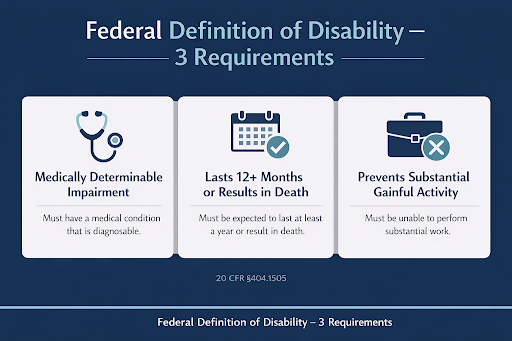
To qualify for Social Security Disability in Florida, you must have a medically determinable impairment expected to last at least 12 months (or result in death) that prevents you from performing substantial gainful activity under federal law (20 CFR §404.1505).
The Social Security Administration (SSA) uses a strict five-step evaluation process.
The Federal Definition of Disability
Under 20 CFR §404.1505, you must:
- Have a medically determinable physical or mental impairment
- That lasts (or is expected to last) at least 12 continuous months
- And prevents you from performing Substantial Gainful Activity (SGA)
2026 SGA Limits
The SSA publishes SGA income limits annually. For 2026:
- $1,690 per month (non-blind individuals)
- $2,830 per month (blind individuals)
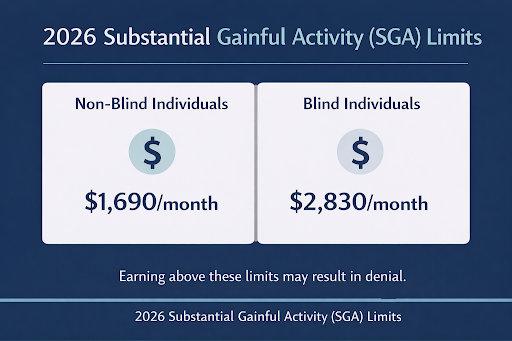
If your earnings exceed these limits, your claim may be denied regardless of medical severity.
(Official SGA tables are published by SSA.gov each year.)
SSDI vs SSI in Florida
Many applicants confuse these programs.
| Feature | SSDI (Social Security Disability Insurance) | SSI (Supplemental Security Income) |
|---|---|---|
| Based On | Work credits & earnings history | Financial need |
| Income Limit | Must be below SGA | Strict income/resource limits |
| Average Monthly Benefit | Based on earnings | Federal maximum rate |
| Medical Standard | Same SSA definition | Same SSA definition |
| Health Coverage | Medicare (after waiting period) | Medicaid |
A disability attorney evaluates which program applies to your situation.
What Types of Disabilities Qualify?
The SSA evaluates conditions under its medical listings (commonly called the “Blue Book”).
Common qualifying conditions include:
- Degenerative disc disease & spinal disorders
- Severe heart disease
- Cancer
- Neurological disorders
- Autoimmune conditions
- Major depressive disorder
- Bipolar disorder
- PTSD
- Schizophrenia
- Traumatic brain injury
Even if your condition is not listed, you may qualify if your functional limitations prevent full-time work.
What Disqualifies You from Disability?
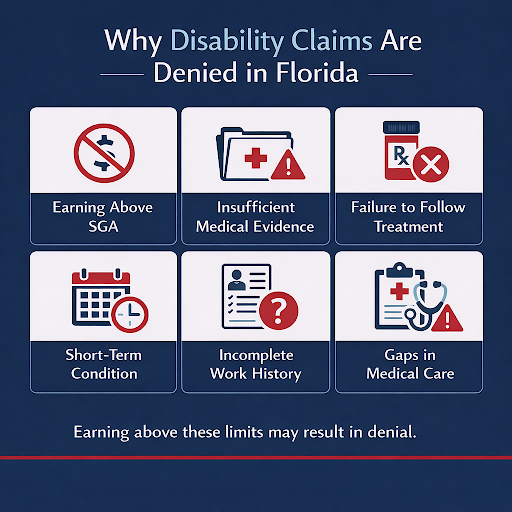
Common denial reasons include:
- Earning above SGA limits
- Insufficient medical documentation
- Failure to follow prescribed treatment
- Short-term or temporary conditions
- Incomplete work history (for SSDI)
- Gaps in medical care
One of the biggest mistakes applicants make is submitting medical records that confirm a diagnosis — but fail to explain functional work limitations.
How Much Does Social Security Disability Pay in Florida?
SSDI payments are based on lifetime earnings. SSI payments are based on financial need. Florida does not set disability payment amounts — benefits are determined by federal SSA formulas.
Average SSDI Benefit
As of September 2025, national averages show monthly SSDI payments typically ranging between approximately:
Your exact amount depends on your work history and earnings record.
Maximum SSDI Benefit
High lifetime earners may receive over:
Keep in mind that the amount a person receives in monthly SSDI benefits depends on their average indexed earnings during their working history, and the SSA recalculates maximum benefit amounts annually.
SSI Payments in Florida
SSI is a needs-based program with a federal maximum monthly payment. Florida may provide limited supplemental assistance in certain circumstances.
Do You Pay Taxes on Disability in Florida?
Florida does not have a state income tax.
Federal taxation may apply depending on total household income.
The Florida Disability Application Process
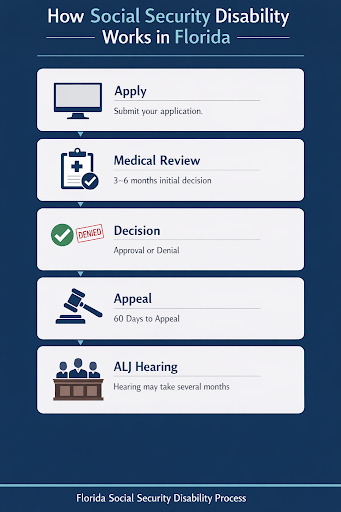
If you are asking, “How do I apply for disability in Florida?”:
Step 1: File Application
You may apply:
- Online at SSA.gov
- By phone
- At a local Social Security office
Step 2: Medical Development
The Florida DDD collects medical records and may request consultative exams.
Step 3: Decision
You receive an approval notice or a denial letter explaining your appeal rights.
Strategic documentation at the beginning often improves long-term outcomes.
Working While on Disability in Florida
The SSA does not limit hours worked — it limits income. If your monthly earnings exceed SGA limits, benefits may stop.
Trial Work Period
SSDI beneficiaries may test their ability to work for 9 months without losing benefits.
Extended Period of Eligibility
After the trial period, you receive a 36-month window where benefits continue if earnings remain below SGA.
Understanding these rules is critical to avoiding overpayment issues.
Official work incentive rules are published by SSA under its disability work program guidelines.
How Long Does It Take to Get Approved in Florida?
Most Florida disability applications take 3–6 months for an initial decision. Appeals and hearings can extend the timeline significantly.
The Florida Disability Review Process
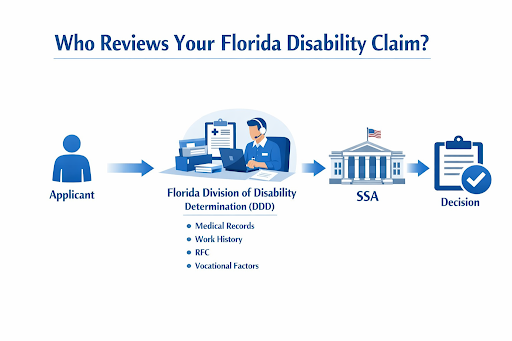
In Florida, initial claims are reviewed by the:
Florida Division of Disability Determination (DDD)
They evaluate:
- Medical records
- Work history
- Residual functional capacity
- Vocational factors
What Happens After a Denial?
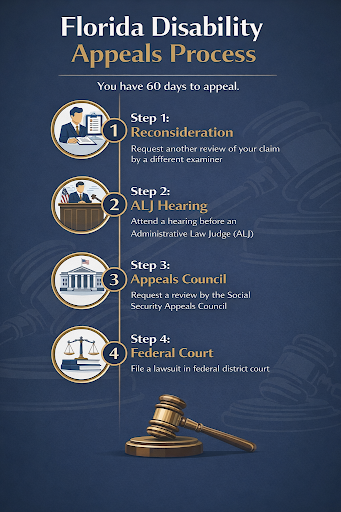
You have 60 days to appeal.
Stage 1: Reconsideration
A different examiner reviews your file.
Stage 2: ALJ Hearing
You may request a hearing before an Administrative Law Judge.
Florida hearings are conducted by SSA’s Office of Hearings Operations (OHO), with offices located in:
- Miami
- Tampa
- Orlando
- Jacksonville
- Fort Lauderdale
- Tallahassee
Approval rates vary by judge and location.
In recent years, Florida ALJ approval rates have fluctuated roughly between 45%–55%, depending on the hearing office and year.
Wait times for hearings in larger metro areas can extend many months from request to decision.
Real Florida Disability Case Examples
2025 Tampa Back Injury Case – Approved at Hearing
In 2025, our firm represented a 52-year-old Tampa construction worker with degenerative disc disease and lumbar radiculopathy.
His initial claim was denied due to insufficient documentation of work-related limitations.
We obtained:
- Updated lumbar MRI imaging
- A detailed residual functional capacity (RFC) evaluation
- Orthopedic specialist treatment notes
- Physical therapy progress documentation
At the Tampa OHO hearing, the vocational expert testified that an individual limited to sedentary work with frequent positional changes had no transferable skills.
The Administrative Law Judge issued a fully favorable decision six weeks later.
Orlando Mental Health Disability Case
An Orlando claimant suffering from major depressive disorder and PTSD was denied at the initial and reconsideration levels.
We presented:
- Psychiatric treatment records
- Medication history
- Therapist functional assessments
- Detailed testimony regarding concentration and attendance limitations
The ALJ determined the claimant could not sustain competitive employment and approved benefits.
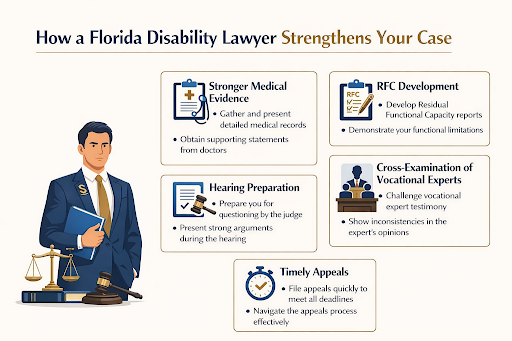
Why Hiring a Florida Social Security Disability Lawyer Can Improve Your Case
Social Security disability law is governed by federal statutes and detailed regulations.
An experienced disability attorney can:
- Ensure medical evidence meets SSA standards
- Develop residual functional capacity arguments
- Prepare you for ALJ testimony
- Cross-examine vocational experts
- Prevent procedural errors
- File timely appeals
Small mistakes can delay benefits for months — or require restarting the process.
About Our Florida Social Security Disability Attorneys
Our firm represents disability claimants throughout Florida, including Miami, Tampa, Orlando, Jacksonville, and surrounding communities.
We:
- Handle SSDI and SSI claims
- Represent clients at an ALJ hearing
- Work on contingency fees
- Follow federal SSA regulations and Florida hearing procedures
If Your Claim Was Denied
You have only 60 days to appeal.
If your application was denied, delayed, or you are unsure how to proceed, reviewing your case strategy now may significantly impact your outcome.
Understanding Florida-specific procedures, SSA regulations, and hearing preparation can improve your chances of approval.
Frequently Asked Questions
How much does disability pay in Florida?
SSDI benefits are based on lifetime earnings and often average around $1,500–$1,700 per month. SSI pays a lower federal maximum benefit based on financial need.
How long does approval take?
Initial decisions typically take 3–6 months. Appeals and hearings may take longer depending on the backlog and location.
What disqualifies you from disability?
Earning above SGA limits, insufficient medical evidence, short-term impairments, or incomplete documentation may lead to denial.
What benefits do disabled people get in Florida?
SSDI recipients may qualify for Medicare after the waiting period. SSI recipients may qualify for Medicaid and other need-based programs.
Do I pay upfront for a disability lawyer?
No. Disability attorneys work on contingency. Fees are limited by federal law and are typically paid from backpay only if the case is successful.