Key Takeaway
|
For 2026, VA disability rates have gone up by 2.8%, and this change is already in place. The new rates became effective on December 1, 2025, with the first updated payments sent out on December 31, 2025.
If you’re a veteran with a 100% rating and no dependents, your monthly compensation has increased from $3,831.30 to $3,938.58. This adjustment happens automatically and remains tax-free, helping you manage rising everyday expenses.
In this guide, you’ll clearly understand how much you can receive in 2026, see detailed pay charts, and learn why this increase may still feel smaller than expected.
What Are The 2026 VA Disability Pay Rates For 10% And 20% Ratings?
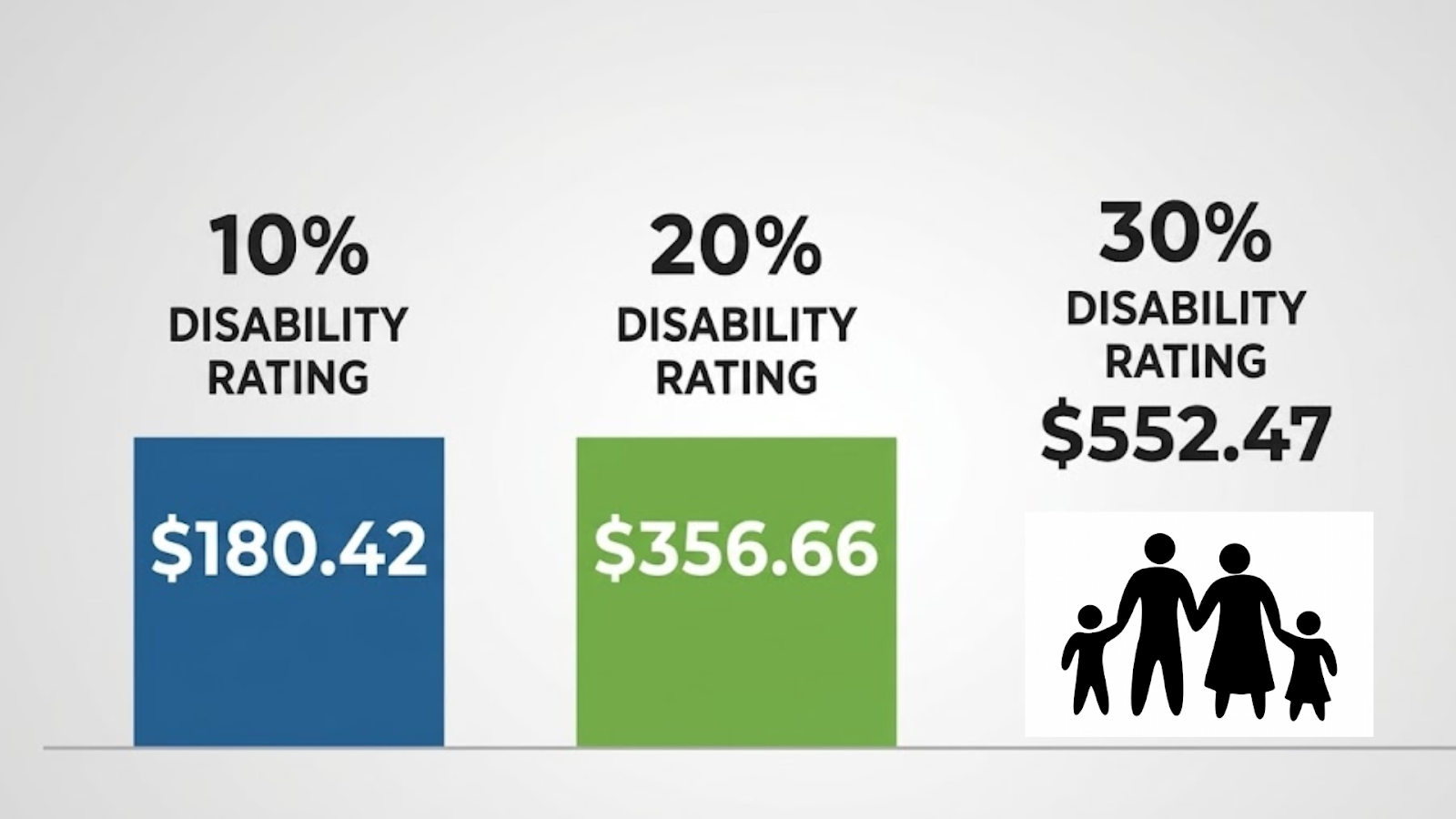
For veterans with a 10% or 20% rating, the VA uses a standard flat payment system. This means everyone at these levels gets the same payment, no matter if they have a spouse, children, or dependent parents. Extra compensation for dependents only starts once your rating reaches 30% or higher.
For veterans with a 10% or 20% rating, the VA uses a standard flat payment system. This means everyone at these levels gets the same payment, no matter if they have a spouse, children, or dependent parents. Extra compensation for dependents only starts once your rating reaches 30% or higher.
| VA Disability Rating | Monthly Compensation |
| 10% | $180.42 |
| 20% | $356.66 |
These payments are tax-free and usually updated automatically if you’re already receiving benefits. If your condition has worsened, aiming for a 30% rating can make a big difference, as it opens the door to extra monthly support for your dependents.
How Much Is The 30% To 60% VA Disability Pay For Veterans Without Children?
Once you reach a 30% VA rating, your benefits start increasing in a more meaningful way. This is also the point where you can add dependents, like a spouse or parents, to your compensation.
Here’s a quick look at the 2026 VA disability rates increase chart for veterans without children:
| Disability Rating | Veteran Alone | With Spouse | With One Parent | With Two Parents |
| 30% | $552.47 | $617.47 | $598.47 | $644.47 |
| 40% | $795.84 | $882.84 | $857.84 | $919.84 |
| 50% | $1,132.90 | $1,241.90 | $1,202.90 | $1,292.90 |
| 60% | $1,435.02 | $1,566.02 | $1,521.02 | $1,635.02 |
Quick Tip:
This is the first level where your VA rate disability isn’t just about your condition anymore; it’s also about your household. That’s why payments can vary even for veterans with the same rating.
What Are The 70% To 100% VA Disability Rates For Veterans Without Children?
When your disability rating falls between 70% and 100%, your VA benefits become a strong financial foundation. At the top tier, a single veteran with a 100% rating earns $3,938.58 per month.
However, veterans with more severe conditions may receive additional support through Special Monthly Compensation (SMC). While SMC-K provides a small monthly add-on of $139.87, higher levels like SMC-S can replace your standard benefit with $4,408.53.
| Disability Rating | Veteran Alone | With Spouse | With Spouse & 1 Parent | With 1 Parent (No Spouse) |
| 70% | $1,808.45 | $1,961.45 | $2,084.45 | $1,931.45 |
| 80% | $2,102.15 | $2,277.15 | $2,417.15 | $2,242.15 |
| 90% | $2,362.30 | $2,559.30 | $2,717.30 | $2,520.30 |
| 100% | $3,938.58 | $4,158.17 | $4,334.41 | $4,114.82 |
How Much Extra Is 30% To 60% VA Disability Pay With Children?
Many veterans ask this: “How much VA disability pay do I actually get if I have kids?”
If you have children at home, hitting the 30% rating mark is a game-changer for your monthly budget. This is the level where the VA finally adds extra cash to your check for your kids, helping to offset those rising grocery and school costs.
| Disability Rating | Vet + 1 Child | Vet + Spouse + 1 Child | Extra Child (Under 18) |
| 30% | $596.47 | $666.47 | +$32.00 |
| 40% | $853.84 | $947.84 | +$43.00 |
| 50% | $1,205.90 | $1,322.90 | +$54.00 |
| 60% | $1,523.02 | $1,663.02 | +$65.00 |
Useful Tip: So if your compensation feels off, it’s worth double-checking your dependents in the VA disability pay chart 2026 with dependents—it could make a real difference.
What Are The 70% To 100% Va Disability Rates With Dependents And Children?
Veterans with a 70% to 100% disability rating receive the highest level of VA compensation. These payments increase further when you have dependents such as a spouse, children, or parents.
| Disability Rating | Vet + 1 Child | Vet + Spouse + 1 Child | Extra Child (Under 18) |
| 70% Rating | $1,910.45 | $2,074.45 | +$76.00 |
| 80% Rating | $2,219.15 | $2,406.15 | +$87.00 |
| 90% Rating | $2,494.30 | $2,704.30 | +$98.00 |
| 100% Rating | $4,085.43 | $4,318.99 | +$109.11 |
Many veterans often wonder:
Is it worth trying to move from 90% to 100%?
Yes, moving from 90% to 100% can add over $1,500 monthly. That’s a meaningful boost to cover bills, healthcare, or household costs, making the effort to apply for an increase very worthwhile.
Why Does The 2.8% 2026 VA Disability Increase Feel So Small?
After the 2026 VA rates were announced, many veterans started asking the same question:
“If there’s an increase in my VA disability compensation, why doesn’t it feel like one?”
While the 2026 VA disability rates increase is technically higher than the 2.5% we saw in 2025, it’s a far cry from the massive 8.7% spike in 2023 or even the 3.2% from 2024. This creates what many call the “math vs. reality” gap.
Here are four conversational ways to explain this,
The “Snapshot” Problem:
The government calculates your raise based only on inflation data from July, August, and September of 2025. This means your COLA increase in 2026 for VA disability is essentially a rearview mirror. It’s looking at where prices were, not where they are now in 2026.
The “Utility Bill” Reality
Overall inflation may be 2.8%, but everyday essentials are rising faster. For example, natural gas went up about 10.9% and electricity increased by 6.7%, which hits your budget more directly.
Money Already Lost To Inflation:
The 2026 VA disability rate increase is 2.8% – a bit better than 2025’s 2.5%. But honestly, this yearly increase only adjusts a little at a time. It doesn’t make up for the big jump in prices over the last few years, so your overall buying power is still lower.
The System Isn’t Fully Updated:
The government uses the CPI-W (Consumer Price Index for Urban Wage Earners), which was created in the 1970s. This doesn’t fully reflect real expenses today. It gives less weight to important costs like housing, transport, and energy—things veterans often spend more on.
What Was The 2026 VA Medication Rule, And Was It Rescinded?
The 2026 “Medication Rule” worried a lot of veterans earlier this year—but it quickly turned into a big relief. Here’s what actually happened and where things stand now:
The “Don’t Choose Between Health and Benefits”
In February 2026, the VA rolled out a rule that could change how disability ratings are decided—based on how you function with treatment. Veterans were worried this could lower their benefits if their medication helped. The reaction was immediate. Advocacy groups pushed back hard, and within just 10 days, the VA reversed the decision on February 27.
So now, things stay the same; your rating is based on your condition, not how well medication controls it.
How Will The New VA AI Fraud-Detection Tool Affect Your Claim?
The VA’s new “Power BI” fraud-detection tool has been a major talking point in 2026. While early reports created a lot of anxiety, a significant policy shift in March 2026 has changed the outlook for most veterans.
The “New Claims Only” Reversal
Initially, the VA planned to use this automated tool to re-scan 1.2 million finalized claims dating back to 2010. The tool is now forward-looking, meaning it will only scan new applications filed in 2026 and beyond. If you already have your rating, it will not be reduced because of this automated scan.
What the Tool Actually Flags
The system isn’t looking for legitimate medical evidence; it’s hunting for “Claim Sharks”—unaccredited companies that use copy-paste medical language to mass-produce claims. The tool flags “telltale signs” such as:
- The 100-Mile Rule: If your medical examiner is located more than 100 miles from your home, the system may flag your claim for a manual review by a human rater.
- “Boilerplate” Language: It looks for repetitive, identical phrasing used across hundreds of different Disability Benefits Questionnaires (DBQs).
- Missing Signatures: Incomplete medical credentials or signature blocks will also trigger a flag.
|
Quick Glance Just came across a Reddit post mentioning a Stars and Stripes article—the VA is getting ready to scan 1M+ disability claims using AI for possible fraud.
|

What Should You Do?
Don’t stress—but do be careful. The key is to make sure your claim is clear, detailed, and personal to your condition.
- Avoid copy-paste reports
- Make sure your doctor includes specific details about your symptoms
- Double-check everything before submitting
When Is The 2026 VA Disability Benefits Schedule For Payments?
Wondering when your 2026 VA disability check will arrive?
The VA follows a pretty consistent schedule each month, and the good news is it’s easy to plan around. Here’s a glance at 2026 payment dates:
| Month | Payment Date | Notes (Weekend Rule) |
| January | Jan 30, 2026 | Paid on the last business day of the month |
| February | Feb 27, 2026 | Paid on the last business day of the month |
| March | Apr 1, 2026 | First falls on a weekend? Paid previous Friday |
| April | Apr 30, 2026 | Last business day |
| May | May 29, 2026 | Memorial Day holiday adjustment |
| June | Jun 30, 2026 | Last business day |
| July | Jul 31, 2026 | Last business day |
| August | Aug 31, 2026 | Last business day |
| September | Sep 30, 2026 | Last business day |
| October | Oct 31, 2026 | Last business day |
| November | Nov 30, 2026 | Last business day |
| December | Dec 31, 2026 | Last business day |
Final Thought
While the 2026 VA disability rate increase is a helpful boost, it may not always cover all your needs. If your condition has changed or worsened, consider applying for a rating increase instead of relying only on the yearly adjustment.
Also, take a moment to review your account and make sure all your spouse, children, or dependent parents are correctly added—small updates can make a noticeable difference in your monthly payment.
If you have any questions or need assistance, don’t hesitate to reach out to Nationwide Disability Representatives for help. We specialize in maximizing VA benefits, guide veterans step by step through the claims process, and ensure all dependents and entitlements are properly recorded.
FAQs
Q: How do I know if I qualify for a higher VA disability rating?
A: You may qualify if your service-connected condition worsens or new symptoms appear. Keep medical records updated, and consider submitting a rating increase claim. A VA representative can guide you step-by-step.
Q: Can I add a new dependent to my VA benefits mid-year?
A: Yes! If you get married, have a child, or support a parent, submit their information to the VA. Your monthly payment may increase immediately, depending on your current disability rating.
Q: Are VA disability payments affected by taxes or other benefits?
A: No, VA disability compensation is tax-free and doesn’t reduce Social Security, pensions, or retirement pay. It’s designed to supplement your income without interfering with other benefits.
Q: Can I get extra VA benefits for caring for my children or parents?
A: Yes! Once your rating is 30% or higher, additional compensation is available for dependents like children, spouse, or dependent parents. Payments increase incrementally depending on household size.
Q: What is Special Monthly Compensation (SMC) and who qualifies?
A: SMC is extra pay for veterans with severe disabilities or loss of use of limbs, or who need aid and attendance. It’s in addition to your base VA rate and can significantly boost your monthly income.