Summary
- The SSA denies about 67% of SSDI applications, mostly for technical or medical reasons.
- Applicants face long delays, averaging over 200 days, often causing “claimant fatigue.”
- Success relies on strong documentation, consistent evidence, and smart legal strategies.
- Even after approval, reviews and overpayment issues can threaten ongoing benefits.
- An experienced disability attorney can turn complex claim struggles into success stories.
The SSA rejects 67% of the SSDI applications. 37% of the applications are denied due to technical reasons, and 30% are rejected due to medical reasons.
It is also a slow process with complex procedural hurdles, stringent evidentiary requirements, and significant administrative delays.
If you are a person with a disability, you might feel that applying for disability benefits is like navigating a maze of endless obstacles. However, with patience, thorough documentation, and persistence, your SSI claim experiences can turn into one of those SSDI success stories.
This article not only explains the challenges associated with disability benefits but also helps you in overcoming disability claims challenges and shares some personal stories of disability claim success.
Challenges in the Application Process
1. The Administrative Black Hole and Procedural Delays
According to the Social Security Administration, the initial review and decision phase should last three to five months, but the actual process takes between six and eight months.
By September 2025, 885,180 initial disability claims were pending, with an average processing time of 209 days. This can create “claimant fatigue,” where some potential beneficiaries abandon their pursuit of legitimate benefits.
Solution: Proactive Case Management and Expediency
This is a legal strategy in which an attorney counters delays by submitting a comprehensive application package immediately. The application includes detailed medical records, work history, and every other required piece of information. This saves time as the SSA does not request additional information.
Moreover, the attorney maintains consistent communication with the Disability Determination Services (DDS) to keep you informed of your application status.
2. Lack of Objective Medical Evidence and Failure to Establish Severity
The SSA requires “objective medical evidence” from an “acceptable medical source”. You need not only to establish an impairment but also to define its severity. The medical evidence must prove that the condition imposes functional limitations.
Solution: Evidence Development and RFC Construction
Your attorney collects evidence for your Residual Functional Capacity (RFC), which defines what you can still physically and mentally do, such as sitting, standing, walking, lifting, carrying, and focusing.
In addition to detailed medical records from the treating source, the attorney also uses detailed functional reports and third-party statements to supplement medical records. This is done to demonstrate that you are unable to do the basic work-related activities required by past employment or any other type of work available in the national economy.
3. The Credibility Trap—Subjective Symptoms
Conditions such as fibromyalgia or severe back injuries present subjective symptoms like chronic pain and debilitating fatigue, which are difficult to quantify. If you don’t support your claim with strong objective findings, or your claim falls into the “credibility trap,” the SSA will dismiss your application. Inconsistency hurts your credibility.
Solution: Corroboration, Consistency, and the Pain Journal
Your disability benefits attorney establishes consistency and corroboration to address this issue. Here is why it is essential to work with an attorney right from the beginning. An attorney helps ensure that your description of pain and limitations is consistent in all of your medical records.
Also, maintain a pain journal to document the daily impact of your condition. Link your functional limitations directly to subjective complaints.
4. Denial Based on Substantial Gainful Activity (SGA)
According to the SSA, a disability is the inability to engage in Substantial Gainful Activity (SGA). You must not be earning above a monthly threshold, which is $2,700 for a statutorily blind individual and $1,620 for a non-blind individual, for 2025.
If you work part-time or briefly return to employment, the SSA may conclude that your disability does not prevent you from earning above the SGA limits.
Solution: Distinguishing Failed Work Attempts and Earning Drops
The attorney can strategically define this period of work as an Unsuccessful Work Attempt (UWA). Your attorney can argue that the work was not sustainable. Termination due to the severity of impairment can be another strong argument.
A comparative financial analysis can demonstrate that you are making much less than you did before the disability. Showing a significant drop in your income proves that you can’t do Substantial Gainful Activity (SGA).
Overcoming Denials
5. Navigating the Shifting Sands of Medical Evidence Rules
According to the “treating physician rule”, if you filed a claim before March 27, 2017, the SSA must adopt the well-supported opinion of your long-term doctor. However, the rule does not apply to claims filed on or after that date.
This change provides the ALJ (Administrative Law Judge) greater discretion, which weakens your reliance on the opinion of your familiar treating source. As judges can prioritize opinions based on supportability and consistency instead of your treatment relationship, this increases the risk of initial ALJ denials.
Solution: Maximize Supportability and Consistency
This rule minimizes reliance on the treatment relationship and maximizes reliance on the quality of the medical evidence. The attorney ensures that the opinion thoroughly explains the functional limitations and objective findings and lab tests back these conclusions. The focus on strong and consistent medical evidence can compel the judge to accept the evidence based on its merit instead of relying on the old rule that favored the patient’s doctor.
6. Adverse Testimony from Vocational Experts (VEs)
At the fifth step of the evaluation process, the ALJ relies on a Vocational Expert’s (VE) assessment to determine if you have the functional capacity to adjust to other jobs available in the national economy.
Your application will be denied if the VE identifies residual, unskilled jobs that you can perform.
Solution: Rigorous Cross-Examination
The attorney can cross-examine the vocational expert at the hearing and present counter-hypothetical scenarios reflecting the full extent of your well-documented limitations.
These limitations also include factors such as the need for unscheduled breaks, frequent absences, severe pain, or difficulties with concentration and persistence. The focus is to prove that no competitive work is available for you in the national economy.
7. Age and Limited Skills (The Vocational Hurdle)
If you are less than 50 years old, the SSA presumes that you can adjust to a new form of work. This makes it difficult to prove that you cannot perform any job in the economy.
Solution: Intensified Focus on Total Functional Impairment
If you are under 50, your attorney can turn your personal disability journey into a disability benefits approval story by proving that your Residual Functional Capacity is so restrictive that you cannot perform any job in the national economy. This is achieved by providing zero adaptability and highlighting non-exertional limitations.
Appeals Council and Federal Court Review
8. Denial at the Administrative Law Judge (ALJ) Level
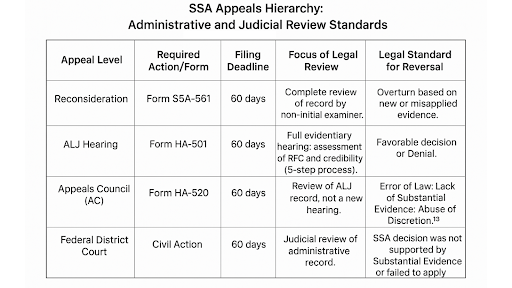
If the ALJ denies your application, you have 60 days to file an appeal to the Appeals Council before the decision becomes administratively final. Keep in mind that this is a high-level review, not a new hearing.
Solution: Identifying Legal Errors and Lack of Substantial Evidence
The attorney meticulously reviews the ALJ’s decision to identify specific grounds for appeal, including:
- Error of Law
- Lack of Substantial Evidence
The attorney can argue that the ALJ failed to apply the correct regulations. Another argument can be that the ALJ relied on limited or flawed evidence to deny the application.
The attorney can also submit new evidence, but it requires demonstrating a good reason behind the late submission.
9. Appeals Council Denial
The Appeals Council can deny the review of your appeal or uphold the unfavorable decision by the ALJ. However, you have one more option to end your disability application struggles.
Solution: Seeking Judicial Review
You can file a civil action in the Federal District Court within 60 days of the Appeal Council’s final decision. The Federal Court reviews administrative records to determine if the SSA has substantial evidence to deny your application and the correct legal standards have been applied.
The goal is to reverse the decision or send the case back to the SSA for a new hearing before a different ALJ.
Post-Approval Complications
10. The Threat of Continuing Disability Reviews (CDR)
The Social Security Disability process does not end even after your application is approved. The SSA initiates Periodic Continuing Disability Reviews to determine if you have undergone sufficient “medical improvement” to engage in Substantial Gainful Activity. If the SSA determines that you can, your benefits can be terminated.
Solution: Defending the Claim using the MIRS Standard
The attorney can invoke the stringent Medical Improvement Review Standard that requires the SSA to justify the termination by proving the following three interconnected elements:
- You have undergone medical improvement
- Your improvement is related to your ability to work
- You can now engage in SGA
Your attorney focuses on proving that, despite the improvements, you have functional disabilities that prevent sustained, competitive work.
11. The Financial Hardship of Overpayments
The SSA can demand repayment due to overpayment. This happens when the beneficiary fails to report changes in income. Sometimes, you have reported the changes on time, but the SSA delays processing and continues paying benefits.
Solution: Strategic Appeal by Waiver or Reconsideration
Your attorney assesses the following three options to address this challenge:
1. Request for Reconsideration
Your attorney can request reconsideration if you believe that the SSA has not overpaid.
2. Request for Waiver
You agree that you are overpaid but believe you shouldn’t have to repay it. Your attorney must prove the following two things to get a waiver:
- Overpayment was not your fault.
- Repayment would either cause financial hardship or be against equity and good conscience.
- Payment Plan
If the first two options are exhausted, your attorney can negotiate a manageable repayment schedule with the SSA.
File a request for a waiver within 30 days of the notice so that the SSA halts overpayment collections.
12. Misunderstanding Work Incentives
The SSA has complex work-related rules when it comes to disability benefits. You have a Trial Work Period (TWP) of nine months to try working without losing your benefits. Keep in mind that those nine months don’t have to be in a row.
Social Security counts these months as any month where your earnings go over a certain amount.
So, you have to track which nine months count as they can spread over five years. If your earnings are too high in the months that follow, you lose your benefits.
Solution: Structured Compliance and Counseling
Speak to a legal counsel who can provide you with the necessary guidance and help you track your earnings.
Our SSDI success stories
Chantise Alston
One of our best disability benefits approval stories is that of Chantise Alston. Chantise had three years of disability application struggles while working with three different law firms. We put that struggle to an end by securing a fast win.
Denis
Another SSDI success story is Denis, who also struggled for three years before we eventually took the case. We helped Denis secure the deserved benefits.
Rick Wood
Tired of the complex application process, Rick Wood relied on Nationwide Disability Representatives, and we took care of everything and helped Rick secure victory.
Conclusion
Instead of navigating the process alone, consider working with someone who understands the system and has the expertise to address both technical and medical challenges.
FAQs
1. What are the most common reasons SSDI applications get denied?
67% of the disability benefits are denied due to:
- Insufficient medical evidence
- Not taking the prescribed treatment
- Engaging in SGA
- Technical issues, such as not having enough credit
2. How long does it typically take to receive a decision on a disability claim?
The initial application is processed within three to six months. However, many applications are denied during the initial stage. The next step is a hearing before an Administrative Law Judge. So, the process can take from six months to two years.
3. What strategies can improve my chances of SSDI or SSI approval?
Make sure your medical records are accurate and consistent. Also, make sure that your work earnings stay below the Substantial Gainful Activity (SGA) limit. Most importantly, hire an attorney.
4. What options do I have if my disability claim is denied?
You have the following options if your application is denied:
- Request for reconsideration
- Hearing by an Administrative Law Judge
- Appeals Council Review
- Federal Court Review
5. What challenges can arise even after my disability benefits are approved?
You may have to face the following four challenges after your application is approved:
- Continuing Disability Reviews (CDR)
- Working While on Benefits
- Changes in Living Situation, such as increased income