Summary
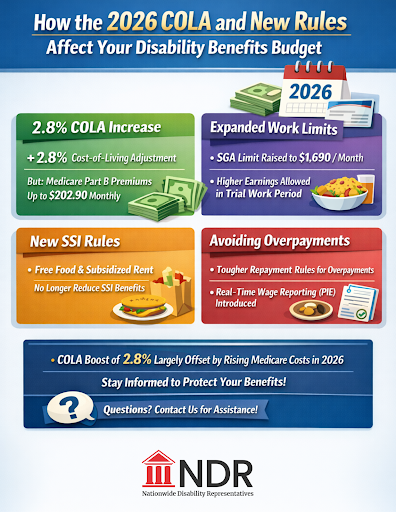
- Social Security benefits will increase by 2.8% in 2026 due to the COLA, but a sharp rise in Medicare Part B premiums will significantly offset the net gain.
- Food assistance and shared meals no longer reduce SSI benefits, giving recipients more flexibility with family or community support.
- Rental subsidies from family are now allowed nationwide without automatic benefit cuts if SSA payment rules are met.
- Work limits increased for SSDI recipients, allowing higher earnings during Trial Work Periods and before hitting SGA limits.
- Stricter overpayment recovery rules for SSDI make accurate wage reporting more critical than ever in 2026.
The SSA introduced a 2.8% Cost-of-Living Adjustment (COLA) for 2026 to help benefits keep pace with inflation. However, while the boost is welcome, a significant 9.7% spike in Medicare Part B premiums ($202.90) largely counterbalances the gain, leaving many with a much smaller ‘net’ increase than expected.
The new year also marks a significant shift in the SSA’s policies. On September 30, 2024, food as In-Kind Support and Maintenance (ISM) was eliminated. This year, you can accept nutritional assistance from family or community networks without triggering an ISM reduction. The SSA no longer considers free groceries or meals countable income that reduces your monthly check.
The Rental Subsidy Exception was officially expanded nationwide on September 30, 2024. This year, you can pay a discounted rental rate to a family member without automatically losing a third of your benefits (provided your payment meets a minimum “business arrangement” threshold: the Presumed Maximum Value).
A rise in the SGA limits is one of the other major Social Security 2026 changes.
Let’s see how the cost-of-living increase for Social Security in 2026 will impact your disability budget.
The 2.8% COLA
The Bureau of Labor Statistics (BLS) inflation data for 2025 was used to calculate the 2026 COLA, which is 2.8%. While the increase is applied automatically to your Primary Insurance Amount (PIA), the actual benefits you will receive depend on your disability program.
| Program Category | 2025 Monthly Base | 2026 Base Adjusted | Average Monthly Increase |
|---|---|---|---|
| SSDI Average (All Workers) | $1,586.00 | $1,630.40 | + $44.40 |
| SSI Federal Benefit (Ind.) | $967.00 | $994.00 | + $27.00 |
| SSI Federal Benefit (Couple) | $1,450.00 | $1,490.60 | + $40.60 |
The “Net vs. Gross” Reality (The Medicare Factor)
While the 2.8% COLA increases your gross benefit, the Medicare Part B premium significantly impacts your final “take-home” amount. The premium is deducted directly from most SSDI checks. The Centers for Medicare & Medicaid Services (CMS) has set the standard premium at $202.90 for 2026, which is nearly a 10% increase from the 2025 rate of $185.00.
The $17.90 premium hike can absorb a large portion of your COLA gain if you are an average disabled worker. For example, if your gross raise is $44.00, after deducting the Medicare premium of $17.90, your actual monthly liquidity only increases by $26.10.
The “Hold Harmless” Safety Net
This provision ensures that your net Social Security check cannot decrease from one year to the next due to an increase in Medicare premiums.
If your specific 2.8% COLA raise is smaller than the $17.90 Medicare increase, the SSA will reduce your premium to ensure that your check remains at least the same dollar amount as it was in 2025.
It is important to understand that the protection does not apply to new Medicare enrollees.
| Cost Category | 2025 Amount | 2026 Amount |
|---|---|---|
| Standard Part B Premium | $185.00 | $202.90 |
| Annual Part B Deductible | $257.00 | $283.00 |
| Part A Hospital Deductible | $1,676.00 | $1,736.00 |
Expanding Your Ability to Work
Many beneficiaries look to part-time work due to rising medical and living costs. The SSA has increased the Substantial Gainful Activity (SGA) and Trial Work Period (TWP) thresholds, which provide you with slightly more “earning room” before your benefits are impacted.
| Category | 2025 Monthly Limit | 2026 Monthly Limit |
|---|---|---|
| SGA (Non-Blind) | $1,620 | $1,690 |
| SGA (Blind) | $2,700 | $2,830 |
| Trial Work Period (TWP) | $1,160 | $1,210 |
Trial Work Period
An SSDI recipient is entitled to a nine-month period to test their ability to work without losing any benefits. You can earn an unlimited amount of income and still receive your full SSDI check during these nine months.
The SGA Ceiling
The $1,690 (non-blind) limit becomes a “hard ceiling” once the Trial Work Period is over. Earning even one dollar above this gross amount can result in a cessation of benefits. The $70 increase from last year’s limit allows a worker at a $15/hour job to work roughly 4.5 additional hours per month.
Expanded Definition of “Public Assistance Household”
The broadened definition of what qualifies as a “Public Assistance Household” protects your benefits from being reduced when living with others. The Supplemental Nutrition Assistance Program (SNAP/Food Stamps) is now included in the list of qualifying programs.
The “One-Member” Rule
Previously, every member of a household had to receive public assistance for the household to be exempt from certain ISM rules. Now, a household qualifies if only one other member receives a qualifying public payment. The rule simplifies reporting and protects the checks of those living in multi-generational homes.
Avoiding the “Overpayment Trap” in 2026
This year, the SSA has updated its overpayment recovery policies and introduced the Payroll Information Exchange (PIE) to help prevent overpayments. The PIE provides your real-time monthly wage data directly from large payroll providers.
Just fill out Form SSA-8240 to allow the SSA to automatically retrieve your pay information, reducing the risk of overpayments caused by delays in manual reporting.
New Garnishment Rules for 2026
The rules for collecting overpayments have changed significantly.
SSI
The recovery rate remains capped at 10% of your monthly benefit.
SSDI
The SSA has reinstated a stricter recovery policy for new overpayment notices issued after March 2025. The agency can now withhold up to 100% of your monthly check to recover the debt. Previously, it was capped at 10% in 2024.
Nationwide Disability Representatives is a leading disability and injury law firm that helps you secure the Social Security benefits you deserve.
Contact us today for a free consultation!
Frequently Asked Questions
How does the COLA adjustment work?
Each year, the SSA compares the inflation data from the current year to the previous year to calculate the Cost-of-Living Adjustment (COLA). The adjustment automatically raises your benefits by a percentage.
How will I know if I am getting a cost-of-living adjustment?
You don’t need to apply for a COLA. The increase will automatically take effect if you are eligible, and it will be reflected in your monthly benefits.
Will the COLA increase be enough to cover higher Medicare premiums?
Not always, as rising Medicare Part B premiums can offset part or all of the increase in your benefits.
Do SSI and SSDI recipients get the same COLA increase?
Yes, the same percentage increase applies to Social Security retirement, SSDI, and SSI benefits.