Summary
Cancer may qualify for disability benefits if it significantly limits your ability to work. The SSA reviews cancer claims based on the type, severity, response to treatment, and lasting side effects. Applicants should submit detailed medical records, treatment history, and evidence of long-term limitations. If a claim is denied, filing an appeal with proper documentation and legal support can improve app
By January 1, 2025, there were 18.6 million cancer survivors in the US, roughly 5–5.5% of the U.S. population. Cancer is a group of diseases characterized by the uncontrolled growth and spread of abnormal cells that form tumors and invade organs. Depending on the type of cancer, it can be physically, emotionally, mentally, and socially challenging for the patient. Cancer treatment often requires its own treatment. Primary therapies such as chemotherapy and radiation target cancer cells but also frequently damage healthy tissue, leading to a range of side effects that must be medically managed.
Is Cancer Considered a Disability?
Yes, cancer is often considered a disability because of the changes it can cause within the body, either directly from the cancer itself or as side effects of its treatment. These changes may impact various bodily systems, including:
- Immune system
- Digestive system
- Bowel
- Bladder
- Brain
- Cell growth
- Nervous system
- Respiratory system
- Circulatory system
- Endocrine system
- Reproductive system
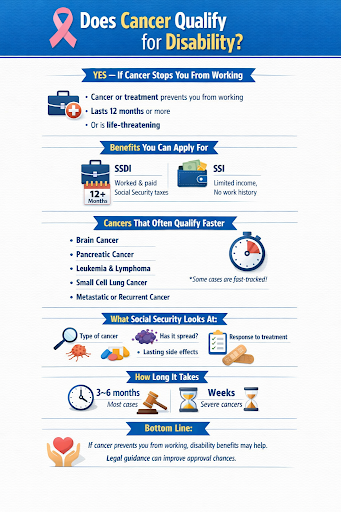
What Disability Benefits Are Available for Cancer Patients?
The SSA offers the following two programs providing monthly assistance to eligible cancer patients:
- Social Security Disability Insurance (SSDI)
- Supplemental Security Income (SSI)
Social Security Disability Insurance
SSDI is available to individuals who have paid Social Security taxes, have the required work credits, and are unable to work due to a serious disability/medical condition.
An applicant with cancer must meet work and medical requirements to qualify for SSDI.
Work Requirements
An adult requires about 40 work credits, of which 20 were earned in the last 10 years. A younger worker may qualify with fewer credits.
Medical Requirements
The cancer must be severe enough to prevent the patient from performing substantial gainful activity (SGA) for at least 12 months or be expected to result in death. The SSA uses the medical evidence and Section 13.00 of the Blue Book for evaluation.
Monthly SSDI payments are based on the past earnings of the beneficiary. The beneficiary also becomes eligible for Medicare after receiving SSDI benefits for 24 months.
Supplemental Security Income (SSI)
It is a need-based (no work history required) disability program for eligible individuals with limited financial resources.
SSI Eligibility
The applicant’s countable resources, such as cash, bank accounts, or property other than a primary home, must be below $2,000 for individuals and $3,000 for couples.
In most states, SSI automatically qualifies for Medicaid access.
| Category | Maximum SSI Monthly Payment |
|---|---|
| Individuals | $967 |
| Couples | $1,450 |
How Does the SSA Determine if Cancer is a Disability?
The SSA applies a series of criteria to cancers that are malignant neoplastic diseases. These are cancers that spread to nearby tissues or other parts of the body. The administration uses the following four medical factors to determine if the cancer is a disability.
| Factor | What Is Considered | Explanation |
|---|---|---|
| Underweight | • BMI below 18.5 | • Indicates insufficient body weight • May be linked to nutritional deficiencies or underlying health conditions |
| Normal Weight | • BMI between 18.5 – 24.9 | • Represents a healthy weight range • Associated with lower risk of chronic diseases |
| Overweight | • BMI between 25.0 – 29.9 | • Indicates excess body weight • Increases risk of conditions like diabetes and heart disease |
| Obesity (Class I) | • BMI between 30.0 – 34.9 | • Signifies high body fat levels • Associated with increased health and mobility concerns |
| Severe Obesity (Class II) | • BMI between 35.0 – 39.9 | • Indicates severe excess weight • Higher risk of cardiovascular and metabolic disorders |
| Morbid / Extreme Obesity (Class III) | • BMI 40.0 and above | • Represents extremely high body fat levels • Can significantly impact daily functioning and overall health |
Required Medical Evidence
The SSA reviews objective medical evidence to determine if the applicant’s cancer meets the requirements.
| Evidence | Purpose |
|---|---|
| Pathology reports (biopsy results, tissue analysis, tumor markers) | Verify the type and characteristics of the cancer |
| Operative notes (surgery reports, biopsy procedures, tumor removal details) | Document surgical procedures related to cancer treatment |
| Imaging and other test results (CT scans, MRI, PET scans, X-rays) | Show the location, size, and spread of the cancer |
Which Cancers Qualify for Disability?
Not all cancers automatically qualify for disability benefits. Some cancers, particularly aggressive or advanced types, may automatically qualify for the Compassionate Allowances program. Other cancers must meet the SSA’s eligibility requirements.
Cancers That Often Qualify
The table below shows the common cancers that qualify for disability:
| Cancer Type | Qualifying Criteria |
|---|---|
| Leukemia | • Acute or chronic leukemia that persists despite treatment • May qualify faster if aggressive or refractory |
| Lymphoma | • Non-Hodgkin or Hodgkin lymphoma that is advanced, recurrent, or resistant to therapy |
| Multiple Myeloma | • Active disease with symptoms such as anemia, bone lesions, or kidney damage |
| Brain Cancer | • Often qualifies automatically due to functional impairment and poor prognosis |
| Pancreatic Cancer | • Usually qualifies under SSA’s Compassionate Allowances due to rapid progression |
| Liver Cancer | • Advanced, metastatic, or unresectable tumors commonly qualify |
| Small Cell Lung Cancer | • Aggressive cancer type that typically meets SSA Blue Book criteria |
| Inflammatory Breast Cancer | • Rapidly progressing form with functional limitations that often qualifies |
Compassionate Allowances for Cancer
Cancers that are part of the Compassionate Allowances (CAL) program are often life-threatening or severely disabling. Therefore, their approval is often fast-tracked.
- Glioblastoma
- Pancreatic cancer
- Small-cell lung cancer
- Certain advanced blood cancers
How Long Does It Take to Get Disability for Cancer?
It takes 3 to 6 months on average. However, it may take longer if medical records are incomplete or additional reviews are required. Applications under the Compassionate Allowances (CAL) program are often processed within a few weeks.
The following issues can slow down the claim:
- Missing or incomplete medical records
- Ongoing evaluations
- Delays in responses from healthcare providers
- Additional functional assessments
Key Steps in Applying for Cancer Disability Benefits
You must have cancer that falls under SSA’s cancer listing. The cancer must either be:
- Inoperable or unresectable
- Persistent or recurrent even after initial anticancer therapy
- Metastatic, meaning it has spread to other parts of the body
- Diagnosed and treated with multimodal anticancer therapy (combination of surgery, chemotherapy, radiation, etc.)
-
Gather Necessary Medical Evidence
- Type and Site of Cancer
You will need medical documentation specifying the cancer’s type, site, and extent of spread (if applicable).
2. Treatment History
Include operative notes, pathology reports, and summaries of medical procedures such as biopsies, surgeries, and treatments.
3. Recurrence or Progression
If the cancer has recurred, persisted, or spread, you will need evidence about the recurrence or progression.
-
Provide Detailed Treatment Information
The SSA needs evidence of the treatment regimen:
- Drugs given (chemotherapy, radiation, etc.)
- Frequency of treatments
- Surgery details (if applicable)
- Any complications of therapy, like neurological or cardiovascular issues, which can also impact your ability to work.
-
Gather Longitudinal Evidence
SSA often needs evidence over a 3-month period after therapy starts to assess whether the treatment is effective. If you have completed treatment, provide evidence of any residual impairments or ongoing complications affecting your ability to work.
-
Application and Disability Determination
After submitting medical evidence, SSA will check if your cancer meets the listing criteria for disability or if your impairment is equivalent to the listings in another body system.
| NOTE: SSA will consider your impairment as disabling for at least 12 months. The disability period may extend further based on the severity of the condition and any post-treatment complications. |
-
Bone Marrow or Stem Cell Transplant Considerations
If you have had bone marrow or stem cell transplantation due to cancer, SSA will consider you disabled for at least 12 months after the procedure. This will depend on the type of transplant (autologous or allogeneic).
-
Medical Equivalency
If your cancer doesn’t meet the criteria of the listed cancer types, SSA may still determine that you qualify based on medical equivalency. This means your impairment may be severe enough to qualify, even if it is not specifically listed.
-
Complete the Application
You can apply for cancer benefits online through the SSA website or by calling SSA ( 1-800-772-1213 between 8:00 a.m. and 7:00 p.m. local time, Monday through Friday) to schedule an appointment. Provide all required medical documentation with your application to ensure a smoother evaluation process.
-
Follow Up on Application Status
After submitting your application, it is important to stay in touch with SSA to track your claim. You may be asked for additional information or clarification.
What if Your Claim is Denied?
Denial does not mean that the applicant is no longer eligible for disability benefits. Often, claims are denied first and approved when appealed. Appeals must be filed within 60 days of receiving the denial notice.
Reconsideration
A new examiner completely reviews the claim. Reconsideration typically takes 3–5 months.
Administrative Law Judge (ALJ) Hearing
A hearing before an Administrative Law Judge (ALJ) is the next option if the reconsideration results in denial. The applicant can explain how cancer is affecting their daily activities and ability to work. Testimony by medical and vocational experts can increase the chances of approval. However, the waiting period can be several months to over a year.
Appeals Council Review (if needed)
If an Administrative Law Judge (ALJ) denies the hearing, the applicant can request a review by the Social Security Appeals Council. It is not a new hearing. The council reviews legal, procedural, or evidentiary errors in the ALJ’s decision. The council may:
- Uphold the ALJ’s decision.
- Send the case back to the Administrative Law Judge for a new hearing.
- Issue a new decision.
Federal Court Review
Filing a lawsuit in the U.S. District Federal Court is the last option if the claim is not approved. There is no new disability hearing or testimony. A federal judge reviews the SSA’s record to determine if the decision was based on legal error or lacked substantial evidence. The federal court may:
- Uphold the SSA’s decision.
- Reverse the decision.
- Send the case back to SSA for a review or a new hearing.
How Can a Disability Attorney Help?
If your initial application is denied, you can appeal the decision. This process may include providing additional medical evidence or attending a hearing with an administrative law judge (ALJ).
This is where hiring an expert disability attorney can improve your chances of a successful appeal. An attorney can help you:
- Prepare for the hearing
- Present your case effectively
- Ensure that all paperwork is submitted on time
With expert legal support, you can navigate the complexities of the appeal process and increase your chances of securing the benefits you deserve.
Conclusion
Living with cancer is already a monumental challenge, and securing the financial support you need shouldn’t add to the stress. If you are unable to work due to your condition or the side effects of cancer treatment, disability benefits may be an essential lifeline. The Social Security Administration provides a clear path for qualifying individuals to receive support, but navigating the application process can be daunting. So, now is the best time to have the right support, such as an experienced disability attorney, who can make all the difference in getting the help you need.
Frequently Asked Questions (FAQs)
What benefits can you get if you have cancer?
If you have cancer and are unable to work due to your condition or its treatments, you may qualify for Social Security Disability Insurance (SSDI) or Supplemental Security Income (SSI). These benefits can help cover living expenses during treatment and recovery.
Does stage 2 cancer qualify for disability?
Stage 2 cancer can qualify for disability benefits if it significantly impairs your ability to work, even if it hasn’t metastasized. The SSA evaluates cancer based on severity, treatment response, and functional limitations, so you may still qualify depending on these factors.
How long does it take to get approved for cancer disability benefits?
The approval process for cancer disability benefits can differ based on the cancer type, its severity, and the supporting evidence submitted. It typically takes three to six months for an initial decision, but approval can take longer if additional documentation is required or the case is appealed.
Can you apply for disability benefits if you’re in remission from cancer?
Yes, you can apply for disability benefits even if you are in remission. The SSA will assess your cancer history, the treatments you’ve received, and any lingering effects from the disease or treatment that continue to impair your ability to work. If your remission is stable, you may not qualify, but if you experience ongoing health issues, you may still be eligible.