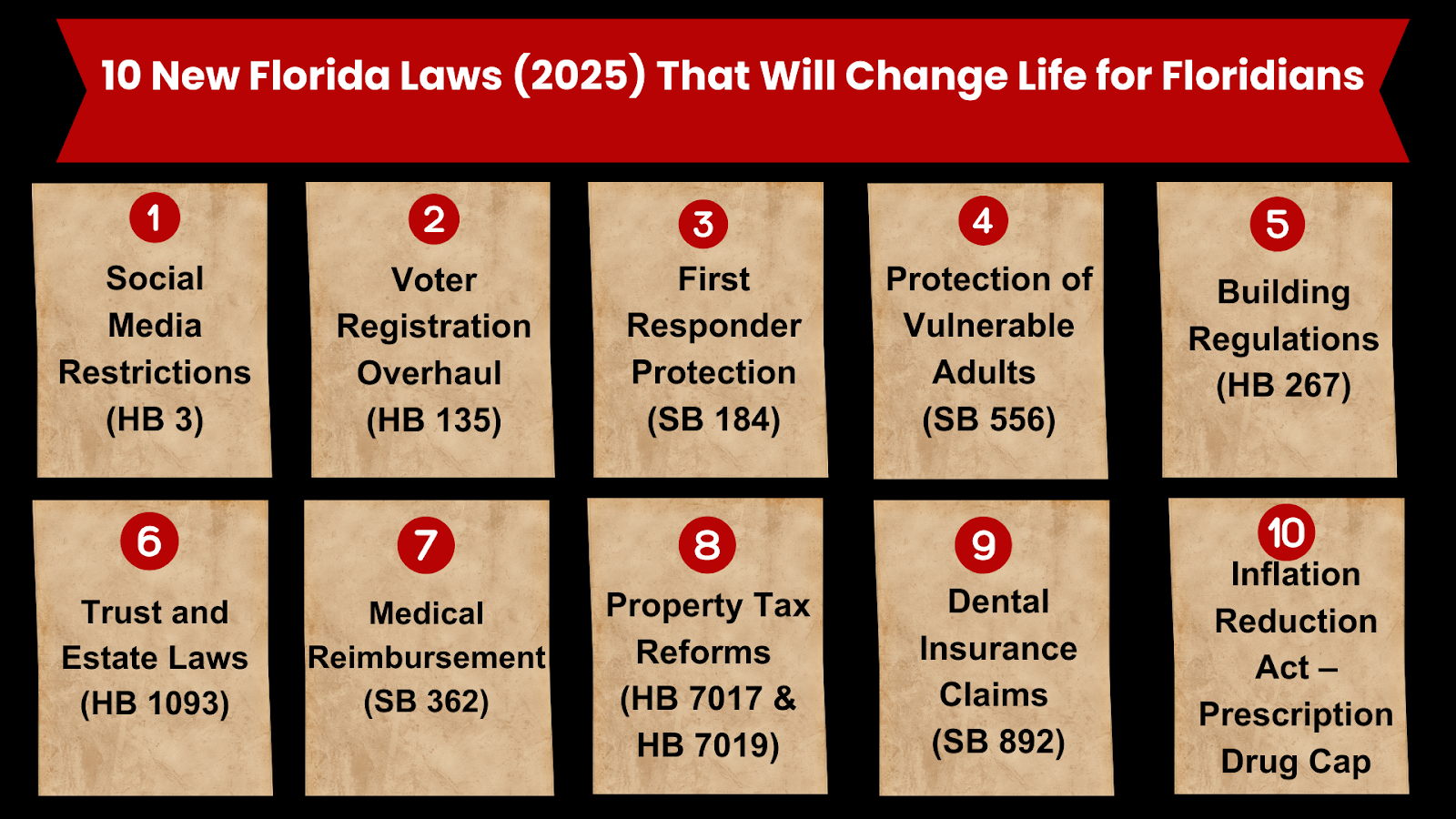
Key Takeaways:
- Florida’s social media restrictions for minors under HB 3.
- Voter registration safeguards under HB 135.
- 25-foot protection zone for first responders under SB 184.
- Financial exploitation protections for seniors under SB 556.
- Extended transaction hold periods under HB 379.
- Faster building permit approvals under HB 267.
- Modernized trust and estate laws under HB 1093.
- Increased workers’ compensation medical reimbursements under SB 362.
- Florida property tax reforms under HB 7017 and HB 7019.
- Medicare prescription drug cost caps under the Inflation Reduction Act.
New year, new laws and Florida is no exception.
January 1, 2025, marked the start of several new laws in Florida. Two months later, many Floridians are still adjusting to how these changes affect their everyday lives.
Whether you are grappling with a social media ban in Florida for minors or wondering how the latest property tax reforms will affect your wallet, these laws are set to significantly reshape life in Florida.
By now, you have likely heard about the recently enacted laws in Florida, but how well do you understand them?
So, here, with a bit more time for reflection and real-world application, this blog provides a deeper look at what these laws truly mean for Floridians — and how you can prepare for their long-term impact.
While others rushed to report the news in January, we are giving you a more thorough breakdown with clearer insights.
Let’s dive into the detailed overview of Florida’s 10 new laws effective from January 1, 2025.
1. Social Media Restrictions for Minors – HB 3
Key Points
HB 3 introduces restrictions on social media usage for minors. Children under 14 will be prohibited from having social media accounts, while 14 or 15-year-olds can access them only with parental or guardian consent.
The law also requires platforms to verify user ages and ensure they don’t allow minors to bypass age restrictions.
The bill regulates social media platforms if they meet the following conditions:
| ✔ Allow users to upload content or view the content or activities of other users. ✔ Have a certain number of active users per day, as defined by the bill. ✔ Use algorithms that analyze user data to choose the content for the users. ✔ Have certain addictive features. |
The social media law in Florida seeks to protect children from the negative effects of social media addiction and data exploitation.
With the rise of online dangers, especially related to addictive features like infinite scrolling and personalized algorithms, parents are now more empowered to manage their children’s online activities.
Practical Tips for Parents:
- Regularly review your child’s social media accounts and ensure compliance with age restrictions.
- Set guidelines for social media usage and discuss potential risks with your children.
- Stay informed about the implementation of these laws by social media platforms and how they may affect your family.
Old vs. New Rules for Social Media Use for Minors
| Aspect | Old Rules (Before HB 3) | New Rules (After HB 3) |
| Minimum Age for Social Media | Platforms allowed minors under 13 with limited restrictions (COPPA). | Bans children under 14 from being account holders. |
| Consent of Parents | Required only for children under 13 (COPPA). | Required for 14 and 15-year-olds. |
| Age Verification | No verification required; users self-reported age. | The Florida law for age verification wants platforms to verify user age via third-party methods. |
| Content Access for Minors | No legal restrictions on harmful content. | Platforms must block harmful content for minors. |
| Enforcement | Platforms were self-regulated. | Platforms can face fines for non-compliance. |
| Accountability for Non-Compliance | Limited legal enforcement. | Fines up to $50,000 per violation. |
While the law was initially blocked by a judge in mid-2025, a federal appeals court ruled in late November 2025 that Florida could begin enforcing it.
2026 Status Update
Active Enforcement
HB 3 is currently enforceable in Florida and major platforms are now legally required to follow these age-restriction and parental-consent rules. However, the broader constitutional battle continues in the courts.
The “ID-for-Speech” Dispute
Whether the age-verification requirement violates the First Amendment rights of adults is the center of the legal debate. It essentially “unmasks” anonymous users by requiring identification.
2. Voter Registration Process Overhaul – HB 135
Key Points:
House Bill 135 (HB 135) was signed into law 2024 and became effective on January 1, 2025. The law stops the DMV from automatically changing political party of the voter by requiring:
- A separate signature
- A printed receipt for every registration update.
The primary goal is to prevent accidental or unauthorized changes to a voter’s party affiliation during driver’s license transactions.
The bill protects voter data and makes the “Motor Voter” regulation process transparent.
If registered voters update their records and they leave the party section blank, they will not be automatically moved to “No Party Affiliation” (NPA).
The law requires the DHSMV to overhaul its IT processes to ensure that system updates do not accidentally alter the party status of the voter without written consent.
3. Protection for First Responders – SB 184
Key Points
SB 184 establishes a 25-foot buffer zone around first responders. Anyone who violates this buffer zone could face fines of $500 and 60 days in jail.
This new traffic law in Florida for 2025 explains how to ensure the safety of first responders by preventing physical and verbal harassment while performing their duties.
Additionally, the bill defines “harass” as willfully engaging in a course of conduct directed at a first responder that causes significant emotional distress and serves no valid reason or purpose.
| Additional Info:
|
Potential Challenges:
- Defining the 25-foot boundary can be difficult in crowded settings.
- There could be mixed reactions from communities, especially where individuals feel their rights to protest or engage with public servants are limited.
4. Protection of Specified Adults – SB 556
Key Points
SB 556 provides crucial protection for specified adults (a person above 65 years or older or a vulnerable adult) who have accounts with financial institutions and may be victims of financial exploitation.
Financial institutions are now required to delay transactions if they suspect exploitation, and they must notify the account holder and trusted contacts within three business days.
| Additional Info: Who is a vulnerable adult?
A person 18 years or older who cannot perform normal daily activities due to mental, emotional, physical, or developmental disabilities, brain injury, or age-related challenges. NOTE: |
Real-World Scenario:
An elderly Florida resident might fall victim to financial abuse by a trusted individual. Under this law, the bank must intervene, delaying transactions and notifying the senior’s family to prevent further harm.
Actionable Advice for Specified Adults:
- Ensure your financial institution has your emergency contact details on file.
- Report any suspicious activity immediately to your bank and loved ones.
HB 379 Amendment
The 45-Day “Hold” Window
The investigation time has nearly doubled with this amendment. Financial institutions can now extend a transaction delay for an additional 30 business days. This brings the total maximum delay to 45 business days.
Inclusion of Investment Accounts
The protection now explicitly covers securities dealers, investment advisers, and brokerage firms. As a result, the same “delay and report” rules protect stocks, bonds, and retirement portfolios (like a 401k or IRA).
Mandatory State Notification
The “voluntary” suggestion is now a legal requirement for the bank. They are now legally required to report suspected exploitation to:
- The Florida Office of Financial Regulation (OFR)
- The Department of Children and Families (DCF)
This must be done within 3 business days of placing a hold.
5. Changes to Building Regulations – HB 267
Key Points
HB 267 introduces changes to Florida’s building codes in 2025, simplifying the permitting and inspection processes.
Local governments must now approve permits within set timeframes, and certain home repairs, such as window or door replacements, no longer require sealed drawings if state standards are met.
Long-Term Impact:
- Homeowners and contractors will benefit from faster approval times for building permits.
- This will likely result in fewer construction delays and a more efficient building process statewide.
The local governments must follow the following once a permit application is complete:
| 30 Business Days | For standard single-family homes (less than 7,500 sq. ft.). |
| 60 Business Days | For larger structures (7,500 sq. ft. or more). |
| 12 Business Days | For projects using a “Master Building Permit.” |
The “Deemed Approved” Penalty
The permit is “deemed approved” if the local government fails to meet these deadlines.
If the deadline is missed after correction is submitted, they must reduce the permit fee by 20% for every business day they are late.
The “Two-Request” Limit
Local governments are now allowed only two requests for additional information. They must offer in-person or virtual meetings to resolve all outstanding issues before making a second request.
6. Modernized Trust and Estate Laws – HB 1093
Key Points
HB 1093 allows trusts to adopt total-return investing and provides an option for existing trusts to convert into unitrusts.
This legal reform in Florida for 2025 aims to modernize estate planning by giving Florida residents more flexibility in managing family wealth.
Tax Implications:
- Florida residents who manage trusts will have access to more efficient tax strategies.
- Unitrusts allow for customized estate management, which may lead to better long-term financial planning.
Decanting Powers
“Authorized trustees” now have broader power to “decant” (move) assets from an old trust into a new one. This further modernizes terms or protects a beneficiary with special needs.
Homestead Protection
According to new rules, moving a Florida homestead into a “Community Property Trust” will not trigger a property tax reassessment.
7. Enhanced Medical Reimbursement Laws – SB 362
Key Points
SB 362 increases the reimbursement rates for physicians and medical providers under workers’ compensation laws.
Increased Reimbursement Rates
- The bill increases the maximum reimbursement for physicians from 110% to 175% of the Medicare reimbursement amount.
- For surgical procedures, the reimbursement rate rises from 140% to 210% of the Medicare amount.
These changes are designed to ensure healthcare providers are fairly compensated for treating injured workers, which may improve the quality of care for employees.
Impact on Healthcare Providers:
- Medical providers will receive higher reimbursement rates, potentially leading to improved services for injured workers.
- The bill also increases fees for expert medical witnesses from $200 to $300 per hour for depositions. If the expert is paid on a daily rate, that maximum rises to $300 per day.
8. Property Tax Reforms for Homeowners – HB 7017 & HB 7019
Key Points
The passage of Amendment 5 modifies how Florida property taxes are calculated for Florida homeowners with a homestead exemption.
This change aims to limit annual property tax increases, providing homeowners with greater financial stability.
How Will Florida’s 2025 Laws Affect Homeowners?
Let’s look at the benefits of property tax reforms for homeowners.
-
- Homeowners can expect more predictable tax increases, which will help maintain affordable housing costs.
- This reform could also have a stabilizing effect on the real estate market by making housing more affordable.
9. Updates to Dental Insurance Claims – SB 892
Key Points
SB 892 introduces significant changes to dental insurance policies, focusing on two main areas:
Payment Methods
It prohibits insurers from requiring dentists to use specific payment methods, giving dentists more flexibility in how they receive payments.
Pre-Authorized Claims
Insurers are not allowed to deny claims for treatments that were pre-approved (prior authorization), making the claims process more reliable and predictable for both patients and dentists.
Here is what patients need to know about Florida healthcare law changes in 2025: The main purpose is to simplify the dental insurance process, helping eliminate unnecessary delays and confusion for dental patients.
Benefits for Consumers
- Patients will no longer be caught in administrative delays, and insurers cannot deny claims for pre-authorized treatments.
- Dental patients can expect smoother, more efficient claims processing.
10. Federal Update: Inflation Reduction Act – $2,000 Prescription Drug Cap
Key Points
The Inflation Reduction Act in Florida introduces a $2,000 annual cap on out-of-pocket prescription drug costs for Medicare recipients starting in 2025.
This legislative update in Florida is designed to make essential medications more affordable for seniors, especially those with high prescription drug costs. Additionally, insulin is capped at $35 per month per covered prescription.
Broader Impact:
- Florida seniors will see significant financial relief with the $2,000 cap on out-of-pocket drug costs, enabling them to access essential medications without facing financial hardship.
- The law also expands the low-income subsidy program (LIS or “Extra Help”) under Medicare Part D, benefiting seniors with incomes up to 150% of the federal poverty level beginning in 2024.
- This federal law enhances Florida’s healthcare system by lowering drug costs, strengthening Medicare, and ensuring increased access to life-saving medications for seniors.
New Update:In 2026, the Medicare Part D out-of-pocket maximum for prescription drugs is set at $2,100. |
Conclusion
Hopefully, you now have the answers to the question: What are the new laws in Florida for 2025?
As the year progresses, several changes in Florida’s state regulations 2025 are reshaping the state.
So, staying updated on the latest Florida policy amendments for 2025 is essential, and don’t hesitate to seek professional advice to navigate these new laws.
Governor DeSantis has recently said he backs the idea of ending state property taxes, which could significantly impact Florida’s tax system.
FAQs
How do Florida’s new social media rules affect parents and teenagers?
Children under 14 cannot create social media accounts, and 14- and 15-year-olds need parental consent. Platforms must also verify ages, helping parents manage their children’s online activity and protect them from harmful content.
What protections do Florida’s 2025 laws provide for seniors and vulnerable adults?
If an exploitation is suspected, financial institutions must delay transactions and notify both account holders. This helps prevent financial abuse of seniors and vulnerable adults.
How do the new building permit timelines benefit homeowners and contractors?
Local governments must now approve permits within the set deadlines which are 30 days for standard homes and 60 days for larger projects.
What should Florida homeowners know about property tax reforms in 2025?
The reforms limit annual property tax increases for homestead-exempt homeowners, helping families plan their budgets and maintain affordable housing costs.
What does SB 184 do to protect first responders in Florida?
SB 184 establishes a 25-foot buffer zone around first responders on duty. Violating this zone can result in fines and jail time. It reduces harassment and ensures first responders can safely perform their duties in public spaces.