seo
Updated January 21, 2026
9 min read

Key Takeaways
|
You cannot drive. You cannot stand at a stove without grabbing the counter. You have fallen — more than once. Your doctor has restrictions in writing, and you have missed weeks of work. And yet the Social Security Administration sent you a letter saying you do not qualify.
That letter is not the final answer. It is a starting point – and most people who fight it, win.
Chronic vertigo caused by a diagnosed condition is legally recognised as a disability under three separate frameworks in the United States: Social Security Disability Insurance (SSDI) or SSI, the Americans with Disabilities Act (ADA), and private short-term disability insurance. The SSA denies the majority of first applications — not because claimants are ineligible, but because the paperwork does not tell the full story. Here we’ll tell you exactly what the SSA needs to see, what your employer is legally required to provide, and what benefits you can receive in 2026.
Is Vertigo Considered a Disability?
Vertigo itself is a symptom, not a standalone disease. It is the sensation that you or your surroundings are spinning — often accompanied by nausea, vomiting, balance failure, and cognitive fog. When vertigo is caused by a diagnosed medical condition and is severe enough to limit your ability to work or carry out daily activities, it legally qualifies as a disability.
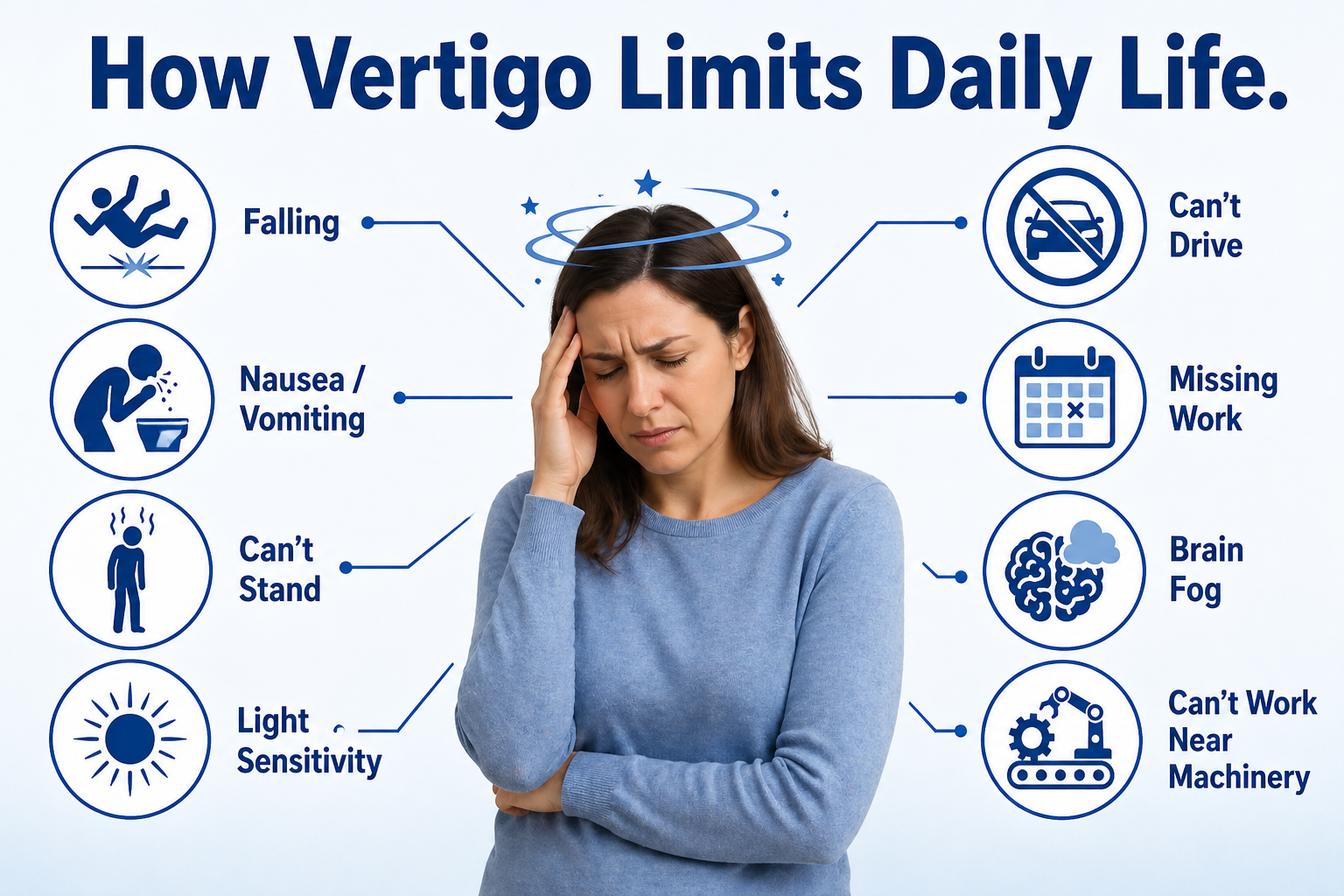
The functional limitations that matter most to the SSA, the ADA, and insurance providers include:
SSA Blue Book Listing 2.07- The Legal Standard
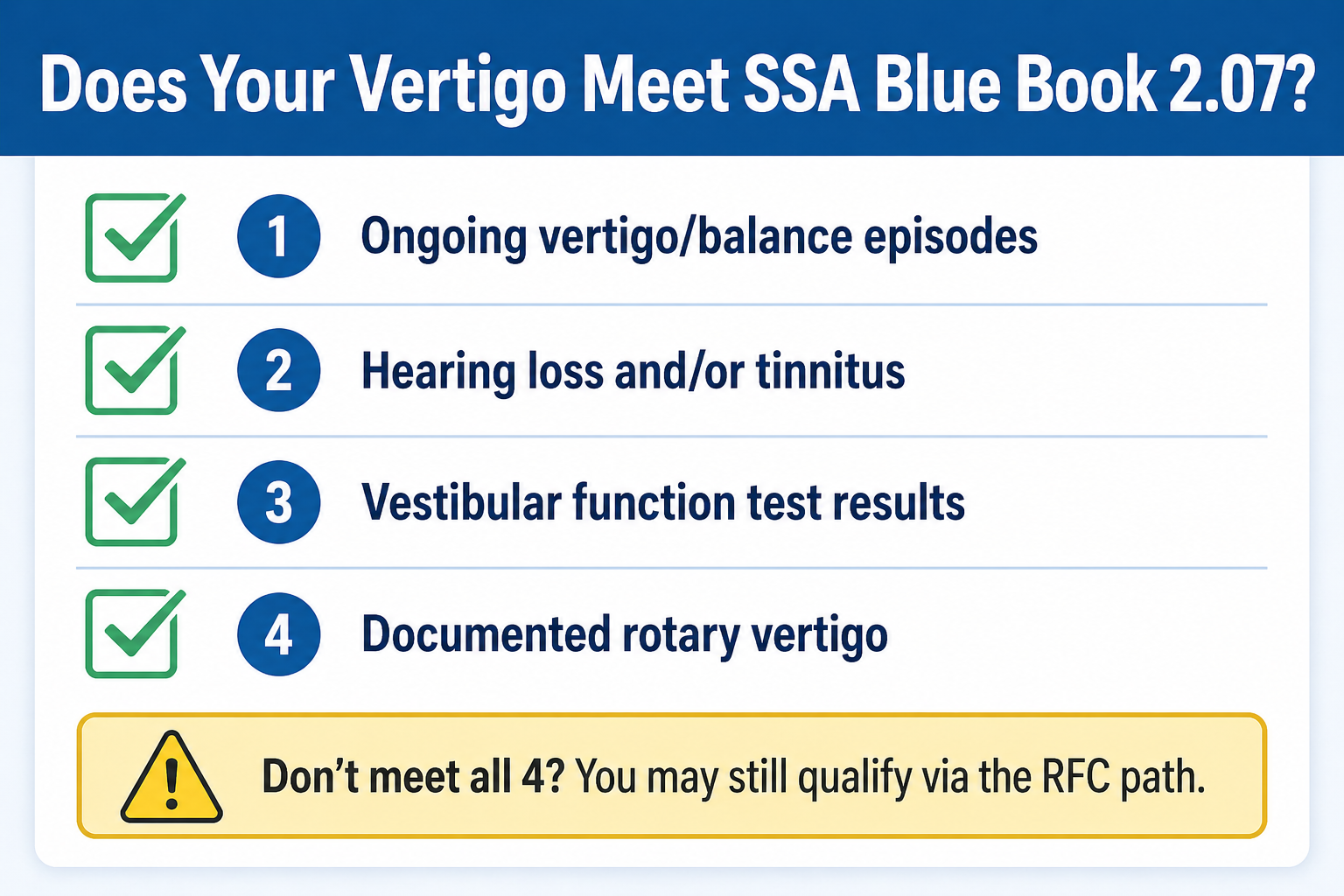
The Social Security Administration evaluates vertigo under Blue Book Listing 2.07 — Disturbances of Labyrinthine-Vestibular Function. This is the specific legal standard SSA reviewers use. To meet it, your medical records must document:
- Ongoing episodes of vertigo or balance disturbance — not isolated or mild symptoms
- Associated hearing loss and/or tinnitus (most commonly tied to Ménière’s disease)
- Vestibular function test results from a qualified specialist
- Clear documentation of rotary vertigo (spinning sensatio
- n) – the SSA distinguishes this from general lightheadedness, and that distinction affects your claim
Important: Not meeting Listing 2.07 exactly does not end your claim. Most vertigo claims are won through the RFC (Residual Functional Capacity) path. |
When Does Vertigo Qualify for SSDI or SSI?
The SSA does not decide disability based on diagnosis names alone. It decides based on what your condition prevents you from doing. The key question SSA asks is: can you sustain full-time work safely and consistently, given everything your vertigo causes?
You may qualify if vertigo prevents you from:
- Standing safely for sustained periods
- Walking consistently without fall risk
- Operating machinery or equipment
- Driving or using public transport alone
- Maintaining a regular work schedule
- Sustained concentration or cognitive focus
The RFC path — when you don’t meet Listing 2.07
Most successful vertigo claims are not won through the Blue Book listing alone. They are won through a Residual Functional Capacity (RFC) assessment — a separate SSA evaluation that asks: given everything your vertigo prevents, is there any full-time job you can safely and consistently perform?
The RFC looks at whether you can stand or walk for six hours in an eight-hour workday, avoid workplace hazards like heights and moving machinery, maintain a reliable pace and attendance, and whether nausea or medication side effects impair your ability to concentrate. Claimants can and should submit their own RFC form from their treating specialist — this is a step most applicants miss.
Conditions commonly linked to disabling vertigo
- Ménière’s disease
- Vestibular migraine
- Labyrinthitis
- Vestibular neuritis
- BPPV (severe, recurrent, or treatment-resistant)
- Traumatic brain injury (TBI)
- Stroke-related vertigo
- Multiple sclerosis (MS)
VA disability benefits for veterans
Veterans with service-connected vertigo — from head trauma, blast exposure, or inner ear injury — may qualify for VA disability ratings under diagnostic codes 6204 (peripheral vestibular disorders: 10–30%) or 6205 (Ménière’s disease: 30–100%) per 38 C.F.R. Part 4 (2026).
You can pursue VA and SSDI claims simultaneously. Learn about VA disability benefits
2026 SSDI benefit figures
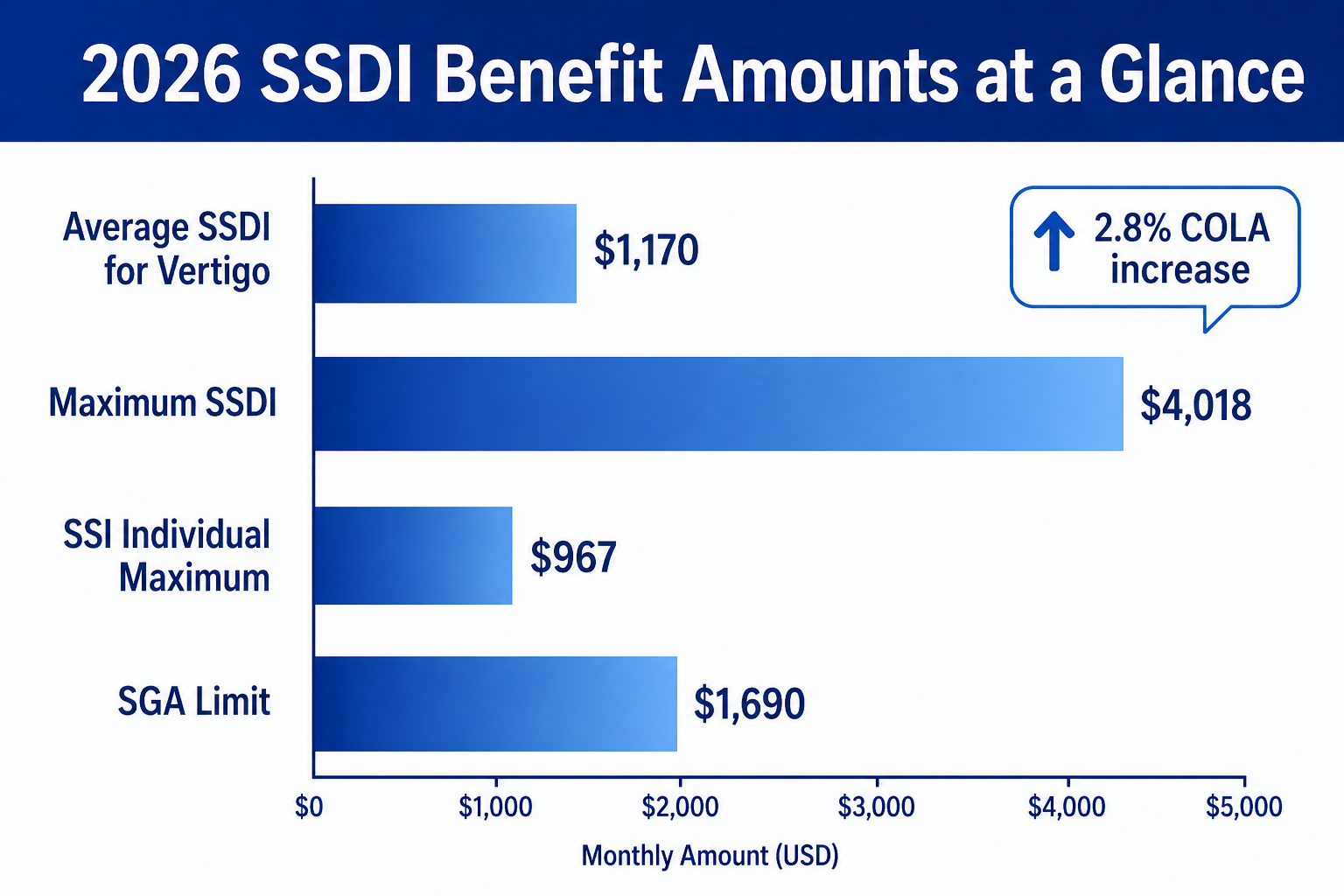
Note: 2.8% COLA (~$44/month average SSDI increase)
Can You Get Short-Term Disability for Vertigo?
Short-term disability (STD) is employer-provided or privately purchased insurance – it is separate from SSDI, which is a federal program. The SSA does not offer short-term disability. STD covers a temporary inability to work, typically lasting weeks to months.
STD may cover vertigo when:
- A sudden severe episode requires hospitalisation or medical leave
- You are recovering after vestibular surgery or a major episode
- Your job involves high-risk duties – driving, operating equipment, clinical nursing, and construction — that become genuinely dangerous
- Your physician certifies that the work poses an immediate safety risk
Typical STD benefit duration
- 6 weeks – standard basic policy
- 12 weeks – extended or employer-enhanced
- Up to 26 weeks – premium or long-term bridge policies
Is Vertigo Protected Under the ADA?
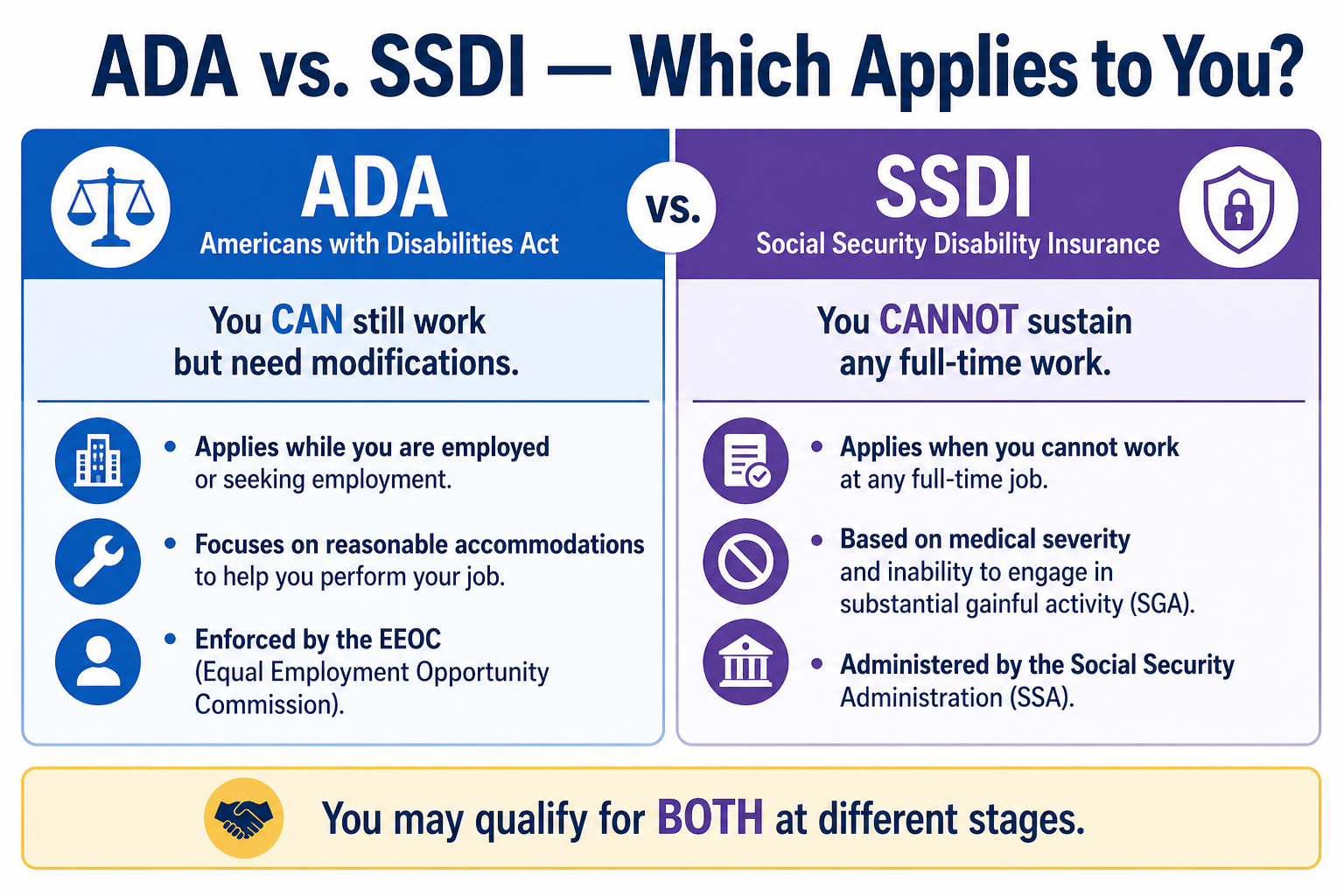
The ADA and SSDI serve different people at different stages. The ADA applies to people who can still work but need modifications to do so safely. SSDI applies to people who cannot work at all. You may be protected under both at different points in your condition, and understanding which applies right now matters.
Vertigo qualifies under the ADA when it substantially limits a major life activity — including walking, driving, concentrating, or working around hazards. Under the ADA, employers with 15 or more employees must provide reasonable accommodations unless doing so causes undue hardship.
Workplace accommodations for vertigo (per JAN, updated April 2026)
| Accommodation type | Practical example |
| Lighting modification | Replace fluorescent lighting with full-spectrum alternatives |
| Workstation adjustment | Seated work arrangement, anti-glare screen covers |
| Environment change | Avoid patterned floor coverings, moving machinery areas |
| Schedule flexibility | Modified shifts, break allowances during episodes |
| Remote work | Work from home during flare-up periods |
| Height/machinery restriction | No ladders, no operation of heavy equipment |
| Alternative transport | Employer-arranged transport if driving is an essential function (EEOC guidance) |
| Leave during flare-ups | Intermittent FMLA leave for unpredictable episodes |
How to request an ADA accommodation
- Get written documentation from your treating ENT or neurologist specifying your limitations.
- Submit a formal written accommodation request to your HR department.
- Engage in your employer’s interactive process — they are legally required to respond.
- If denied, file a complaint with the EEOC or consult a disability attorney immediately.
What Conditions Cause Disabling Vertigo?
| Condition | Can it be disabling? | SSA pathway | Key notes |
| Ménière’s disease | Yes | Blue Book 2.07 | Hearing loss + unpredictable attacks |
| Vestibular migraine | Yes | RFC assessment | Episodic, can be severely disabling |
| BPPV | Sometimes | RFC assessment | Only if frequent or treatment-resistant |
| Vestibular neuritis | Sometimes | RFC assessment | Depends on recovery timeline |
| Stroke-related vertigo | Yes | Neurological listings | Combined neurological deficits |
| MS-related vertigo | Yes | Neurological listings | Chronic and progressive |
| TBI-related vertigo | Yes | Head injury listings / VA codes | Common in veterans; dual VA + SSDI path |
Medical Evidence Needed for a Vertigo Disability Claim
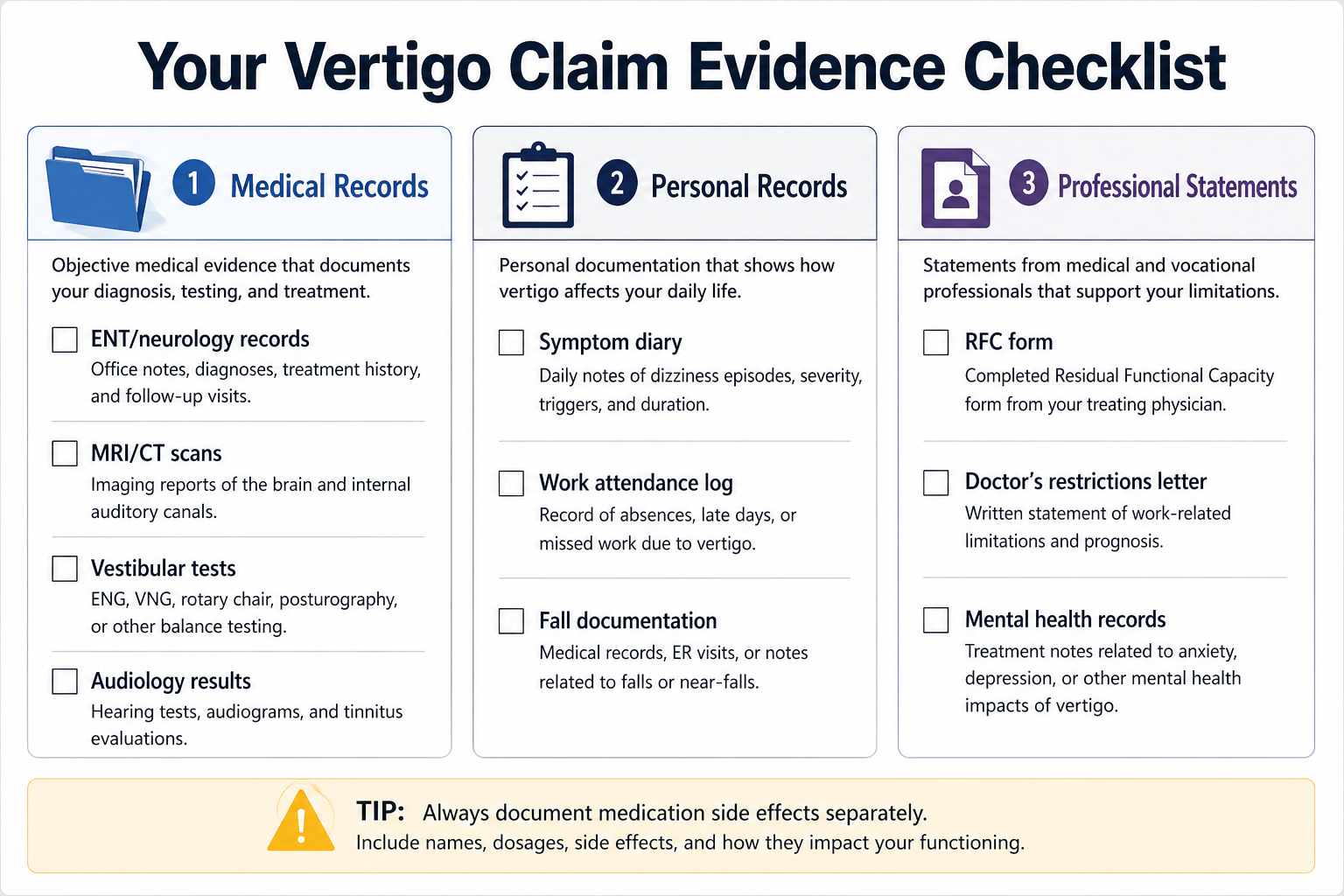
The strength of your claim is only as strong as your paper trail. The SSA needs to see a consistent, documented picture of how your vertigo limits your life — not just a diagnosis.
- ENT / neuro-otolaryngologist records
- Neurology records
- MRI or CT scan (for central vertigo, stroke, TBI)
- Audiology testing (pure tone, speech, Békésy)
- Vestibular function test results
- Emergency room visit records
- Medication history and side effects log
- Vestibular rehabilitation notes
- Symptom diary (minimum 6 months)
- Work attendance records
- Doctor’s restrictions letter / RFC form
- Mental health records (anxiety/depression from vertigo)
- Documentation of falls or fall-related injuries
Tip: document medication side effects separately
Drowsiness, cognitive fog, and coordination problems caused by vestibular suppressants can independently prevent work — and must appear explicitly in your records. Many claims are strengthened significantly once medication side effects are properly documented.
Why Vertigo Claims Get Denied
Understanding common denial reasons before you apply — not after — is one of the most valuable things you can do for your claim.
- Symptoms undocumented between episodes — gaps in records suggest the condition is manageable.
- Missed specialist appointments — SSA interprets these as evidence the condition is not severe.
- No clear underlying diagnosis — “vertigo” alone without a diagnosed cause is rarely sufficient.
- Medical records describe mild symptoms but the claim asserts severe limitations — inconsistency is a red flag.
- SSA determines sedentary work remains possible — even if you can’t do your old job, any full-time job may defeat the claim.
- Lack of specialist evidence — GP records alone rarely carry enough weight; ENT and neurology records are essential.
- Failure to document medication side effects — cognitive fog and drowsiness from suppressants must appear explicitly in records.
How to Apply for Disability Benefits for Vertigo
SSDI / SSI application
- Gather all medical records — minimum 12 months of consistent treatment history.
- Document functional limitations in writing via a daily symptom diary and work attendance log.
- Obtain an RFC / work restriction letter from your treating ENT or neurologist.
- Submit your claim at ssa.gov, by phone or at your local SSA office.
- Attend all SSA-requested medical evaluations without exception.
- If denied — appeal immediately. Most first applications are denied; the appeal stage is where most claims are won.
Short-term disability application
- Contact your HR department or insurance provider for the correct claim forms.
- Obtain physician certification from your ENT or neurologist.
- Submit within your policy deadline — typically within 30 days of onset.
- Follow your prescribed treatment plan throughout the benefit period.
How to Strengthen Your Vertigo Disability Claim
- Keep a daily symptom log with dates, duration, severity, and triggers for at least 6 months.
- See your specialist consistently — treatment gaps undermine credibility with the SSA.
- Record all falls and near-falls in writing; these are objective evidence of functional limitation.
- Follow your prescribed treatment plan fully — non-compliance is one of the most common denial triggers.
- Proactively submit your own RFC Assessment form to the SSA from your treating specialist.
- Document every missed work shift with employer records and written confirmation.
- If you also have anxiety, depression, or hearing loss – document them all. Combined impairments can meet or exceed SSA thresholds even when vertigo alone does not.
Conclusion
Vertigo can qualify as a disability under Social Security Administration rules, Americans with Disabilities Act protections, and private disability policies—but only if you prove functional limitation, not just diagnosis. Most claims fail due to weak documentation, not ineligibility. Build consistent medical evidence, secure a strong RFC, and appeal aggressively. Approval depends on proof, not symptoms alone.
Your vertigo is real. Your claim can be won. Our team has helped people in exactly your situation. The consultation is free.
Get a Free Consultation