admin
Updated May 12, 2026
8 min read
Key Takeaways
|
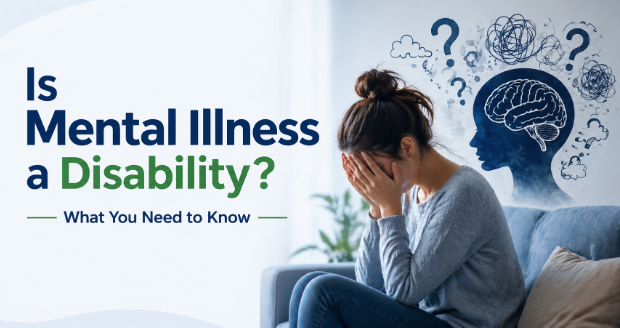
Mental illness can qualify as a disability, but approval is not automatic. Many people lose benefits simply because they do not understand how strict the SSA rules really are. Eligibility depends on how severely your condition affects your ability to work, function, and get through daily life, not just the diagnosis itself.
If you are confused, overwhelmed, or already denied, this guide breaks down which mental health conditions qualify, how to file a strong claim, and what steps you can take if your application has been denied, so you don’t have to figure it all out alone.
What Does “Disability” Mean Under Social Security Law?
To understand whether mental illness is a disability, you first need to understand how disability is defined under U.S. Social Security law.
The SSA defines disability as a medical condition, physical or mental, that prevents a person from performing substantial gainful activity (SGA). In simple terms, this means the condition must prevent someone from working and earning a minimum income. So if a mental health condition prevents you from maintaining full-time employment, you can be eligible for disability benefits.
There are three key requirements:
- The condition must be medically documented.
- It must last at least 12 months or be expected to last that long.
- It must severely limit the ability to work and perform daily activities.
So, disability is not based solely on diagnosis. It is based on functionality, like what a person can or cannot do because of their condition.
Do Mental Illnesses Qualify for Disability?
Yes! Mental illnesses absolutely qualify for Social Security disability benefits, but the condition must meet specific clinical standards. The SSA maintains a document called the Blue Book (formally, the Listing of Impairments), which lists all medical conditions, including mental disorders, that can qualify. Mental disorders are covered under Section 12.00 of the Blue Book.
The SSA groups qualifying mental conditions into the following categories:
| Category | Examples of Conditions |
| Neurocognitive Disorders | Dementia, traumatic brain injury, Alzheimer’s disease |
| Schizophrenia Spectrum | Schizophrenia, schizoaffective disorder, delusional disorder |
| Depressive Disorders | Major depressive disorder, persistent depressive disorder |
| Bipolar Disorders | Bipolar I, Bipolar II, cyclothymic disorder |
| Anxiety & OCD-Related | Generalized anxiety, panic disorder, PTSD, OCD |
| Somatic Symptom Disorders | Somatic symptom disorder, illness anxiety disorder |
| Personality Disorders | Borderline personality, paranoid personality disorder |
| Autism Spectrum Disorder | Autism, Asperger’s syndrome (in adults) |
| Neurodevelopmental Disorders | ADHD (severe), intellectual disabilities |
| Eating Disorders | Anorexia nervosa, bulimia nervosa |
Whether you are dealing with disability for anxiety, disability for depression, or disability for bipolar disorder, we have dedicated resources for each condition. Take a look at the one you want to learn more about in depth.
| READ MORE: You can review the full mental disorders listing directly on the SSA’s Blue Book — Section 12.00 Mental Disorders. |
How to Claim Mental Health Disability Benefits?
Here is a step-by-step breakdown of how the process works:
Step 1: Gather Medical Documentation
Your claim lives or dies on your medical records. You will need:
- Psychiatric evaluations and diagnoses from licensed mental health providers
- Records of hospitalizations, crisis episodes, or emergency care
- Medication history and treatment notes
- Documentation of how the condition affects your ability to work and perform daily activities
- Statements from therapists, psychiatrists, or case managers
Step 2: Choose Your Application Method
You can apply for Social Security mental disability benefits in three ways:
- Online at ssa.gov/applyfordisability
- By calling the SSA at 1-800-772-1213 between 8:00 a.m. – 7:00 p.m.
- In person at your local Social Security office
Step 3: Complete the Adult Function Report
Along with your application, the SSA will ask you to complete an Adult Function Report (SSA-787). This document asks how your mental illness affects your daily life, such as personal care, cooking, social interactions, and your ability to concentrate. Be thorough and honest here. Vague answers are a leading reason claims get denied.
Step 4: Attend a Consultative Examination (If Required)
The SSA may request a consultative examination (CE) with a doctor or mental health professional that it contracts with. Attend this appointment and describe your worst days, not your best.
Step 5: Wait for a Decision
Initial decisions typically take 3 to 6 months. If approved, benefits are retroactive to your established date of onset. If denied, you have 60 days to appeal.
What Evidence Does the SSA Look for in Mental Health Disability Claims?
The SSA evaluates mental health claims under a framework that looks at both the severity of symptoms and their impact on four broad areas of mental functioning:
- Understand, remember, or apply information
- Interact with others
- Concentrate, persist, or maintain pace
- Adapt or manage oneself
Each area is rated on a five-point scale: None, Mild, Moderate, Marked, or Extreme. A rating of “Marked” in two areas, or “Extreme” in one area, generally satisfies the functional criteria under Section 12.00.
Denied Disability for Mental Illness? Here’s What to Do
Being denied disability for mental illness is frustrating, but it is also extremely common. Remember, a denial is not the end of the road.
You have four levels of appeal:
- Reconsideration: A second review by a different SSA examiner (typically still has a low approval rate).
- Hearing before an Administrative Law Judge (ALJ): The most important stage. Here, the approval rates are significantly higher with proper representation.
- Review by the Appeals Council: A review board that can send your case back to an ALJ.
- Federal Court: A lawsuit in a federal district court if all SSA levels are exhausted.
The typical time limit of appeal is 60 days. If you do not appeal on time, the Appeals Council may dismiss your appeal.
| NOTE: If you file an appeal after the deadline, you must explain the reason you are late and ask us to extend the time limit. The people in the Social Security office can explain further and help you file a written request to extend the time limit. The Appeals Council will consider your request and decide whether to extend the time limit. |
If you have been denied disability benefits for a mental illness, our team at Nationwide Disability Representatives can help. An experienced disability lawyer can guide you through the application or appeal process, making it smoother and more effective, and help you secure the benefits you rightfully deserve.
Common Mistakes That Lead to Denial of Mental Health Disability
- Not treating your condition consistently: Gaps in treatment signal to the SSA that your condition may not be severe.
- Downplaying symptoms during examinations: Always describe your worst days, not your best
- Failing to submit complete medical records: Missing records are a top reason for denial
- Not appealing on time: You only have 60 days from a denial notice to request reconsideration
- Going to an ALJ hearing without representation: This is one of the costliest mistakes applicants make
Can You Work While Receiving Mental Health Disability Benefits?
Yes, but with strict limits. The SSA allows beneficiaries to test their ability to return to work through programs like the Social Security Ticket to Work Program, which supports career development for individuals aged 18 through 64 who receive Social Security disability benefits and want to work.
The Ticket to Work Program is free and voluntary. It is designed to help people with disabilities move toward financial independence by connecting them with the services, training, and support needed to succeed in the workforce. Learn more about work incentives at the SSA’s Work Incentives Planning and Assistance (WIPA) page.
| The upcoming free WISE webinar, scheduled for May 27 at 3 p.m. ET, is designed to help individuals explore how the Ticket to Work Program and other SSA Work Incentives can support their employment journey. During the session, participants will gain access to valuable resources to help them decide whether returning to work is the right choice, understand how to find suitable employment, and learn strategies to succeed in the workplace. Registration is now open for the WISE webinar. Please fill out the form if you want to attend. |
Conclusion
Mental illness can be life-altering, but it is important to know that support is available. Under Social Security law, mental health conditions can qualify as a disability when they significantly limit a person’s ability to work and manage daily life. However, approval is not based solely on diagnosis; it depends on strong medical evidence, clear documentation, and the severity of the condition’s impact on daily functioning.