admin
Updated April 9, 2026
4 min read

Summary
|
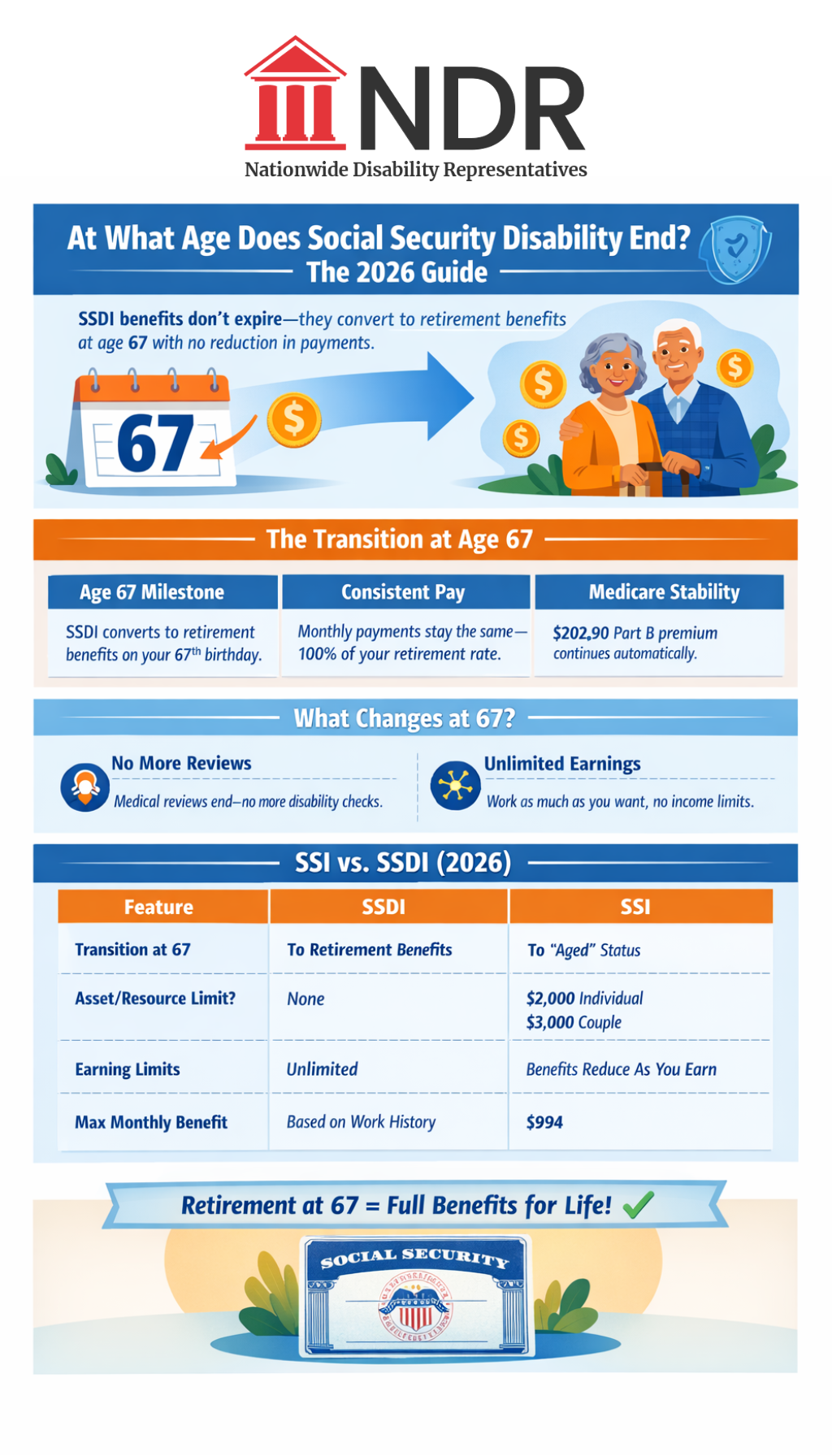
Your Social Security Disability Insurance (SSDI) benefits do not end at the age of 67. The SSA automatically converts your Social Security benefits into Social Security retirement benefits after retirement. If you were born in 1960 or later, your benefits are converted at age 67. If you were born before 1960, the transition depends on your birth year. It can range from 66 to 66 and 10 months.
Your monthly payment amount typically remains the same, as SSDI already pays the equivalent of 100% of your retirement benefit.
So, the short answer to the question “At what age does Social Security disability end?” is that it doesn’t actually end. It just transitions to retirement benefits.
What Changes and What Stays the Same?
While the transition at age 67 is seamless, you need to understand some critical legal and financial shifts.
What Does Not Change
The Payment Amount
SSDI is already calculated at 100% of your primary insurance amount. So, your monthly benefits remain the same.
Medicare Coverage
If you were already on Medicare through SSDI, your coverage and ID card remain the same, and you can continue seeing the same doctors who accept Medicare. However, your $202.90 Part B premium will now be deducted from your retirement check instead of your disability check.
What Changes
No More Medical Reviews
The SSA stops conducting Continuing Disability Reviews, which means you no longer need to prove your disability to keep your benefits.
No More Earnings Limits (SGA)
The 2026 monthly SGA limit for SSDI is $1,690 for non-blind individuals and $2,830 for blind individuals. However, there is no such limit once you hit age 67. Now, you can work full-time and earn an unlimited amount of money.
The “Disability Freeze” Ends
Your benefits are calculated on the basis of the average of your 35 years with the highest earnings. When you stop working due to illness, those years of $0 income would reduce your average earnings, and you would receive a smaller check.
However, the SSA uses a Disability Freeze for individuals on SSDI. The Disability Freeze ignores the years you were too sick to work. This protects your average earnings from dropping. When you reach age 67, the SSA locks in your benefits at the higher rate based on your actual working years. As a result, you do not lose money just because you were disabled.
The 2026 “Grid Rules”
As you get older, it becomes harder to learn a new job. This is why the SSA uses the Medical-Vocational Grid Rules to evaluate disability claims.
In addition to your medical records, the SSA also considers the following:
- Age
- Education
- Past work skills
- Residual Functional Capacity (RFC)
These rules make it difficult for the SSA to deny or stop your benefits as you get closer to retirement age.
Closely Approaching Retirement Age (50-54)
You are typically limited to sedentary work. You must have few or no transferable skills to qualify, and your chances of approval are moderate.
Advanced Age (55-59)
You are able to perform light work with limited or non-transferable skills. Your chances of approval are higher.
Closely Approaching Retirement Age (60+)
You may qualify even if you are capable of medium work. Lack of transferable skills significantly improves your chances of approval.
As you get closer to full retirement age, the Grid Rules make it easier to stay on SSDI until your benefits automatically transition to retirement.
SSI vs. SSDI
SSI and SSDI follow different rules when you reach the Social Security age limit for retirement.
SSI vs. SSDI comparison (2026):
| Feature | SSDI | SSI |
| Transition at 67 | To retirement benefits | To “Aged” status |
| Asset/Resource Limit | None | $2,000 for an individual and $3,000 for a couple |
| Earning Limits | Unlimited | Benefits drop as you earn |
| Max Monthly Benefit | Based on your work history | $994 |
Conclusion
“What age does disability stop?” is one of the most commonly asked questions by Social Security beneficiaries. When you reach your full retirement age, the Social Security Administration officially closes your disability claim and opens your retirement claim. There is no stress of medical eligibility.