admin
Updated December 26, 2023
10 min read

A Social Security Disability lawyer helps strengthen your claim by gathering medical evidence, completing Social Security Administration (SSA) paperwork accurately, meeting deadlines, communicating with the SSA, and representing you during appeals or hearings if needed.
As disability becomes more common, understanding the claims process is increasingly important. The latest Annual Disability Statistics Report found that the percentage of Americans living with a disability increased from 14.04% in 2023 to 14.14% in 2024. Meanwhile, the U.S. Department of Veterans Affairs (VA) processed more than 2 million disability benefits claims by June 1, 2026, highlighting the growing demand for disability assistance across the country.
If you’re unable to work because of a disability, navigating SSA requirements can feel overwhelming. This guide explains how a Social Security Disability lawyer supports your claim, when you should consider hiring one, and how legal guidance can help you avoid costly mistakes throughout the process.
What Does A Social Security Disability Lawyer Do?
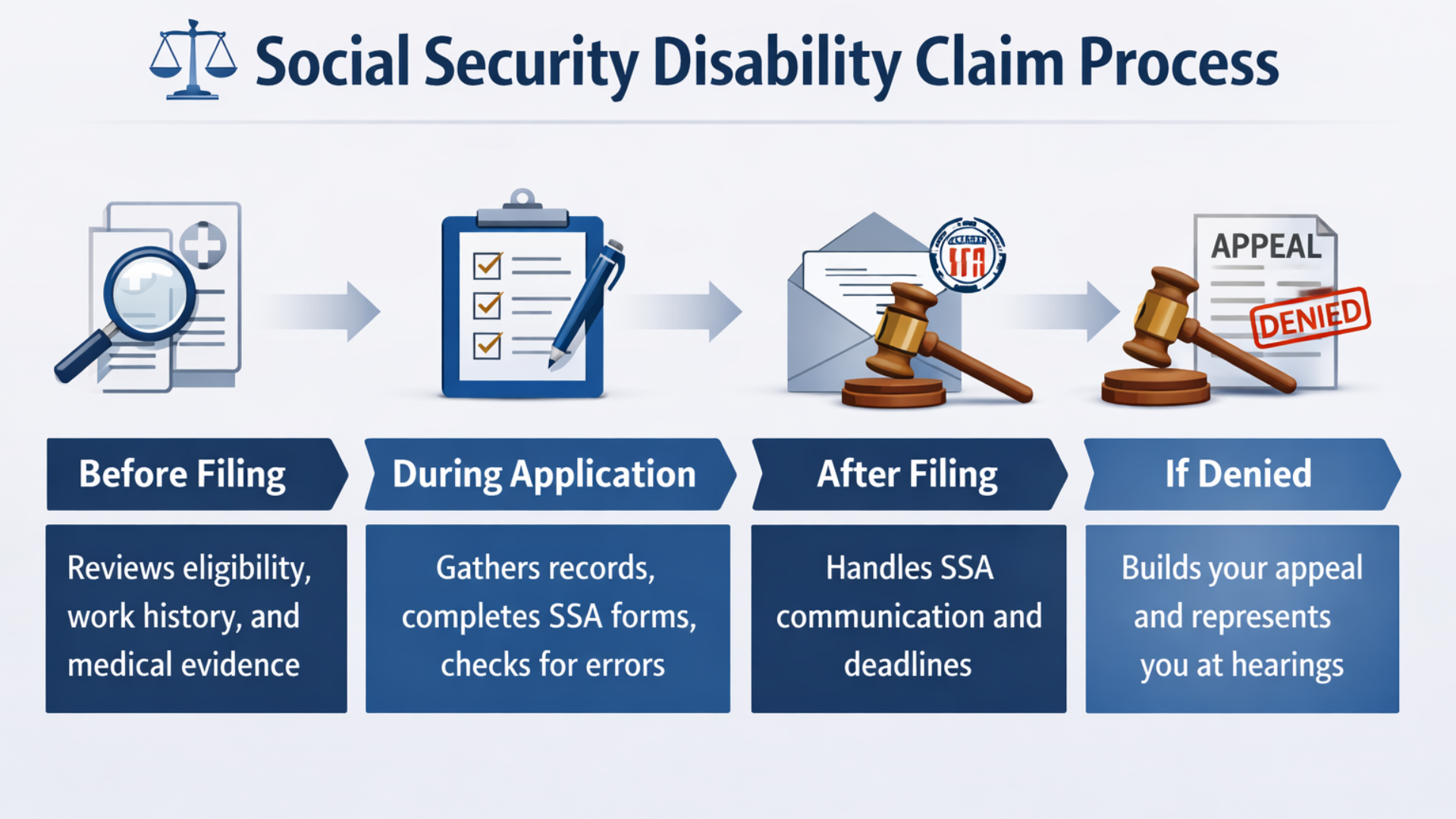
A Social Security Disability lawyer prepares, files, and manages your disability claim from start to finish. Their core job is making sure your application, medical evidence, and paperwork meet the Social Security Administration’s (SSA) requirements and representing you if your claim is denied and needs to go to appeal.
Evaluates Your Eligibility
A disability lawyer determines whether you qualify for SSDI or SSI before you file, and which program fits your situation. SSDI is based on your work history and Social Security tax credits, while SSI is a needs-based program with strict income and asset limits, and some claimants qualify for both.
They review your work credits, diagnosis, treatment history, and how your condition limits your ability to work. Catching eligibility issues early prevents a denial you could have avoided, or a claim filed under the wrong program.
Gathers Strong Medical Evidence
Medical evidence is the deciding factor in most disability claims, and your lawyer builds it for you. They request records, test results, and treatment notes directly from your doctors, and can obtain a physician’s statement connecting your diagnosis to your functional limitations.
If a gap exists (a missing specialist visit, an outdated test), they identify it and get it filled before the SSA sees an incomplete file.
Completes and Reviews SSA Forms
Disability applications are denied for paperwork errors as often as they are for medical reasons, and this is where a lawyer prevents that.
They complete each SSA form, cross-check it against your medical file for inconsistencies, and confirm every required document is attached before submission, reducing the back-and-forth that slows a claim down.
Communicates With the SSA
Once your claim is filed, your lawyer becomes your point of contact with the SSA. They track deadlines, respond to requests for additional information, and submit follow-up documentation on your behalf, so a missed letter or an unanswered request doesn’t stall or sink your claim.
Represents You During Appeals and Hearings
If the SSA denies your claim, your lawyer builds and argues your appeal. They analyze the denial reasons, gather any new evidence needed, and represent you in front of an Administrative Law Judge (ALJ) at your hearing. If the case continues further, they can also represent you at the Appeals Council or in federal court.
Helpful Tip: Bring a complete list of your doctors, medications, treatments, recent test results, and hospital visits to your first consultation. Having this ready lets your lawyer evaluate your case accurately and catch missing evidence before your claim is filed. |
When Should You Hire A Social Security Disability Lawyer?
You can hire a Social Security Disability lawyer at any stage of the process, but the earlier you bring one in, the more they can prevent, rather than just fix. Most claimants wait until after a denial to seek help, but a lawyer can add value from the very first application through federal court, if your case goes that far.
Before Filing
Hiring a lawyer before you file gives you the best chance of a first-round approval.
- Confirms your eligibility for the correct program, whether it’s SSDI, SSI, or both.
- Review your medical evidence to ensure it clearly supports your disability before you apply.
- Completes and checks your paperwork to reduce errors, missing information, or inconsistencies.
- Helps prevent common filing mistakes that can lead to delays or denials.
- Strengthens your initial application, giving you the best chance of approval without going through the appeals process.
- Reduces the risk of avoidable denials, as many initial claims are denied due to incomplete evidence or application errors.
After a Denial
This is the stage when many people first seek legal help after receiving a denial. If your initial application is denied, a lawyer reviews the SSA’s specific reasons and builds a plan to address them.
- You generally have 60 days from the date you receive your denial notice to request reconsideration.
- They identify missing, incomplete, or unpersuasive medical evidence.
- They gather additional documentation to strengthen your case before you refile.
- They ensure your reconsideration request is complete and submitted within the required deadline.
During Reconsideration
A lawyer strengthens your case during reconsideration by adding new medical evidence rather than resubmitting the same file.
- A different SSA examiner reviews your claim during reconsideration.
- The process is similar to the initial review.
- Resubmitting the same information usually doesn’t improve the outcome.
- A lawyer helps address the issues that led to the original denial.
Before an ALJ Hearing
This is the stage where legal representation matters most, and the data backs that up. Claimants who appear before an Administrative Law Judge (ALJ) with legal representation are generally more likely to receive a favorable decision than those who represent themselves.
During the hearing, a Social Security Disability lawyer can:
- Prepare you for the questions an ALJ is likely to ask.
- Organize your medical records into a clear, chronological case.
- Present evidence that supports your disability claim.
- Explain how your condition affects your ability to work.
- Question vocational or medical experts who testify at your hearing.
- Address legal or procedural issues that may arise during the hearing.
During Appeals Council Review
If the ALJ denies your claim, a lawyer can request an Appeals Council review and argue that a legal or procedural error affected the outcome. The Appeals Council review is more limited than earlier stages of the disability claims process.
- It primarily examines whether the law was applied correctly or if the evidence was evaluated properly.
- The Council does not simply reconsider your case because you disagree with the ALJ’s decision.
- Strong legal arguments and identifying procedural or legal errors are critical at this stage.
- An experienced Social Security Disability lawyer can prepare a well-supported appeal that focuses on these specific issues.
Quick Checklist: Signs You Need a Lawyer ✔ Your claim was denied ✔ You have multiple medical conditions ✔ Your medical records are incomplete or hard to obtain ✔ You’re unsure how to complete SSA forms accurately ✔ You’re preparing for an ALJ hearing ✔ You’ve missed a deadline or are unsure how much time you have left to appeal ✔ Your condition isn’t a “listed” impairment and needs a medical-vocational argument |
How Much Does A Social Security Disability Lawyer Cost?
Most Social Security Disability lawyers work on contingency, meaning you pay nothing upfront and owe a fee only if you win your case. The Social Security Administration (SSA) regulates and must approve this fee before your lawyer is paid; it isn’t something the attorney sets independently.
- No upfront fees: You don’t pay hourly rates or retainers to start your case.
- Pay only if you win: If your claim is denied and you don’t recover benefits, you owe no attorney fee.
- The SSA sets and approves the cap: Your lawyer can’t collect more than the government-approved limit, regardless of how much work the case required.
According to the Social Security Administration (SSA), attorney fees approved under a standard fee agreement are generally limited to 25% of your past-due benefits or $9,200, whichever is less, for favorable decisions issued on or after November 30, 2024. This limit applies only to attorney fees and does not include certain approved case-related expenses, if applicable.
Example: How Attorney Fees Are Calculated
Suppose you’re awarded $40,000 in past-due Social Security Disability benefits.
| Calculation | Amount |
| Past-due benefits | $40,000 |
| 25% of past-due benefits | $10,000 |
| SSA attorney fee cap | $9,200 |
| Attorney receives | $9,200 (the lower amount) |
| You receive | $30,800 |
What if your past-due benefits were lower?
If you received $20,000 in past-due benefits, 25% would be $5,000. Because $5,000 is less than the SSA fee cap, your attorney would receive $5,000, and you would receive the remaining $15,000.
| Note: This is a simplified example based on a standard SSA fee agreement. Attorney fees must be approved by the SSA, and case-related expenses, such as obtaining medical records, may be separate from the attorney fee. |
What Can’t A Social Security Disability Lawyer Do?
A Social Security Disability lawyer can strengthen your case, but they can’t guarantee an outcome or influence how the SSA decides your claim. Understanding these limits helps you set realistic expectations and spot any attorney who promises more than the law allows.
Cannot Guarantee Approval
No lawyer can guarantee your claim will be approved. The SSA or an Administrative Law Judge makes the final decision based on your medical evidence and work history.
Cannot Influence SSA Decisions
A lawyer cannot influence SSA examiners or judges. They can only present your evidence clearly and build the strongest possible case.
Cannot Change Eligibility Rules
Attorneys cannot change SSA eligibility requirements, such as work credit rules for SSDI or income limits for SSI. They help you meet the existing requirements.
Cannot Speed Up Every Claim
A lawyer may help avoid unnecessary delays by submitting complete and accurate paperwork, but they cannot control SSA processing times or hearing schedules.
Cannot Create Medical Evidence
Lawyers can collect and organize your medical records, but they cannot create or alter medical evidence. Your healthcare providers must document your condition and treatment.
Helpful Tip: If an attorney guarantees approval or promises a specific timeline before reviewing your medical records, treat that as a red flag rather than reassurance. No one can honestly make that promise this early in the process. |
Common Mistakes That Can Hurt Your Claim
Small errors and oversights are one of the most common reasons disability claims are delayed or denied, even when the underlying medical condition clearly qualifies. Avoiding these mistakes gives your claim a stronger chance of success at every stage.
- Missing deadlines: Appeals deadlines are typically 60 days from the date of your notice. Missing one can mean starting your claim over from scratch instead of continuing your appeal.
- Submitting incomplete medical records: Gaps in treatment history, missing specialist visits, or outdated test results can make your condition look less severe than it actually is.
- Leaving questions blank on SSA forms: Incomplete answers can trigger delays while the SSA requests clarification, or be interpreted in ways that don’t reflect your actual limitations.
- Continuing to work above SSA income limits: Earning above the substantial gainful activity (SGA) threshold can lead the SSA to conclude you’re not disabled, regardless of your medical condition.
- Missing scheduled medical appointments: Gaps in treatment can be read as a sign your condition has improved, even if the missed appointment was unrelated to your disability.
- Giving inconsistent information: Contradictions between your application, medical records, and hearing testimony can undermine your credibility with an examiner or judge.
- Waiting too long to seek legal help: The earlier a lawyer reviews your claim, the more issues they can prevent rather than fix after a denial.
Final Thought
Applying for Social Security Disability benefits is more than just completing paperwork—it’s about presenting a well-supported claim that clearly demonstrates how your condition affects your ability to work. A knowledgeable disability lawyer can help you prepare a stronger application, avoid common pitfalls, and guide you through every stage of the claims or appeals process.
If you’re ready to move forward or need answers about your case, contact Nationwide Disability Representatives today for a free case review and personalized guidance.