Home » Florida Personal Injury Lawyer » SSI Eligibility in Florida: Who Qualifies, Income Limits & How to Apply

SSI Eligibility in Florida: Who Qualifies, Income Limits & How to Apply

  • Home
  • /
  • SSI Eligibility in Florida: Who Qualifies, Income Limits & How to Apply

SSI Eligibility in Florida

Key Takeaways

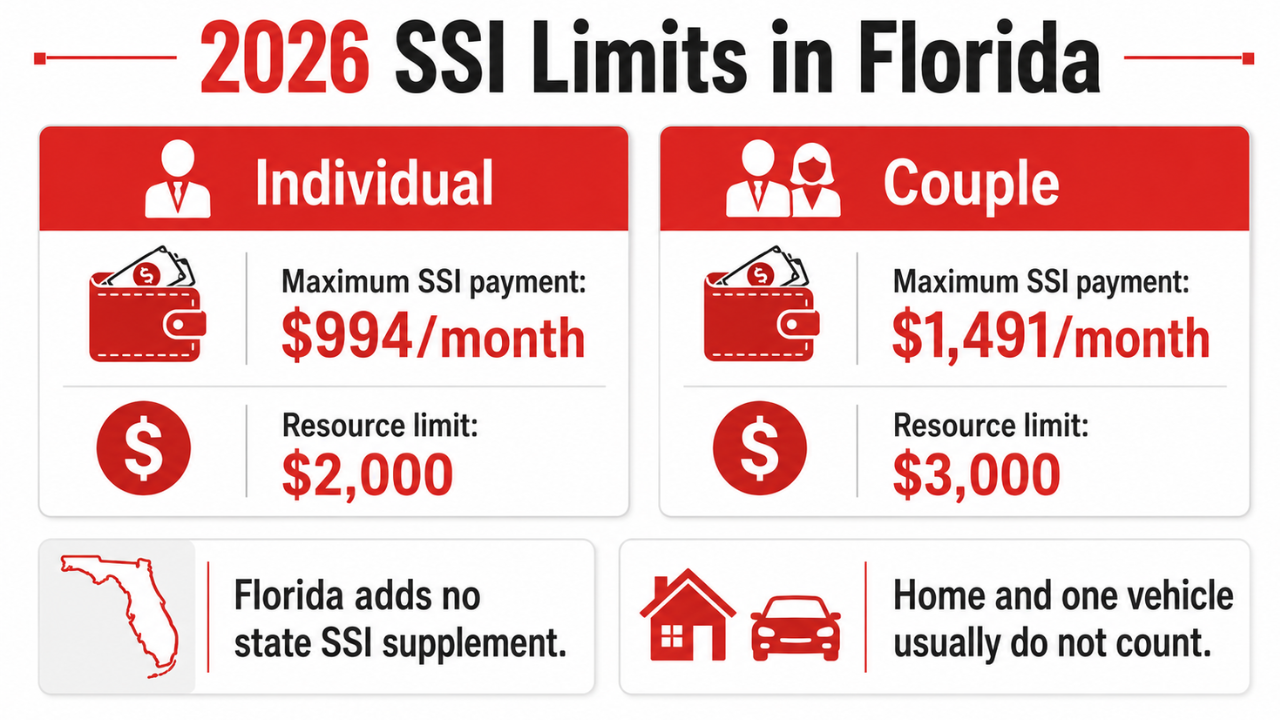
  • 2026 max SSI payment: $994/month for an individual, $1,491/month for a couple
  • Resource limit: Under $2,000 (individual) or $3,000 (couple); your home and one vehicle don’t count
  • Florida adds no state supplement. You receive the federal amount only.
  • Eligible if you are: 65+, blind, or have a disability expected to last 12+ months
  • No work history required. SSI is based on financial need, not prior employment (unlike SSDI).
  • SSI approval usually means automatic Medicaid in Florida.
  • Denied? You have 60 days to appeal. Appealing (not re-filing) preserves your original application date and back pay. 

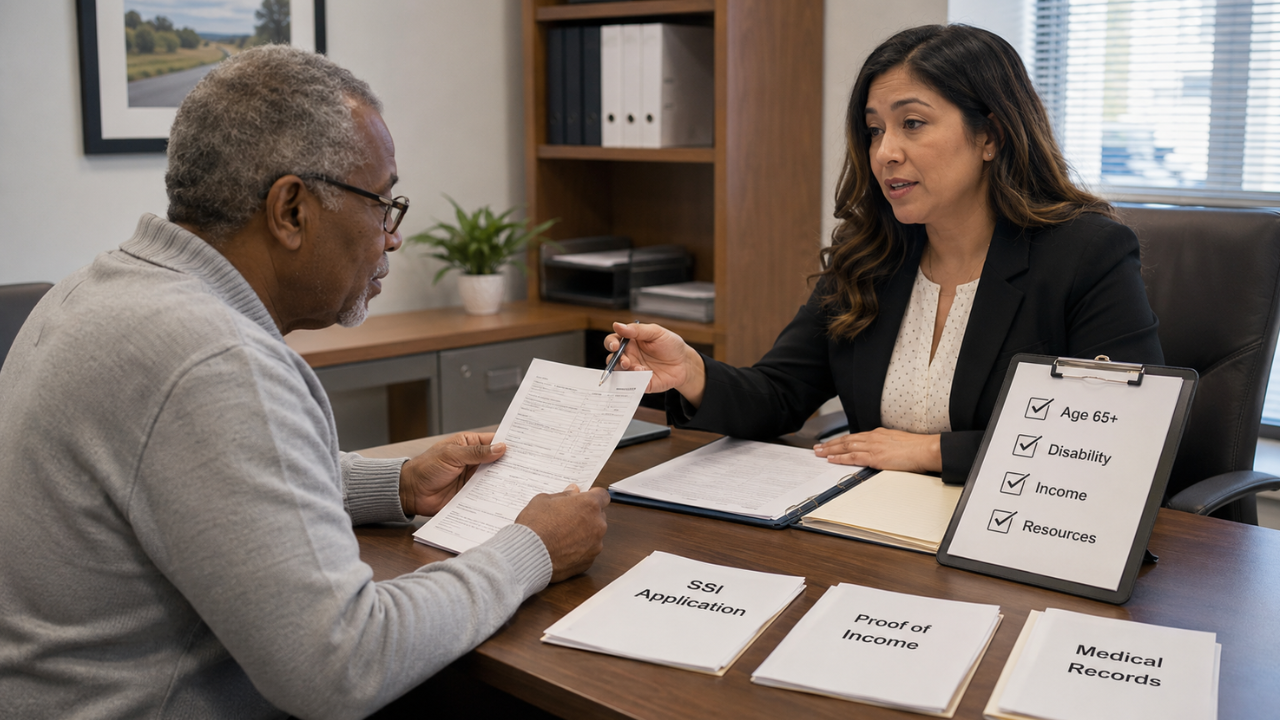
To qualify for Supplemental Security Income (SSI) in Florida, you must meet certain requirements. You must be 65 or older, blind, or have a qualifying disability. You must also have limited income and limited resources. In most cases, your countable resources must be less than $2,000 if you are single or $3,000 if you are a couple.

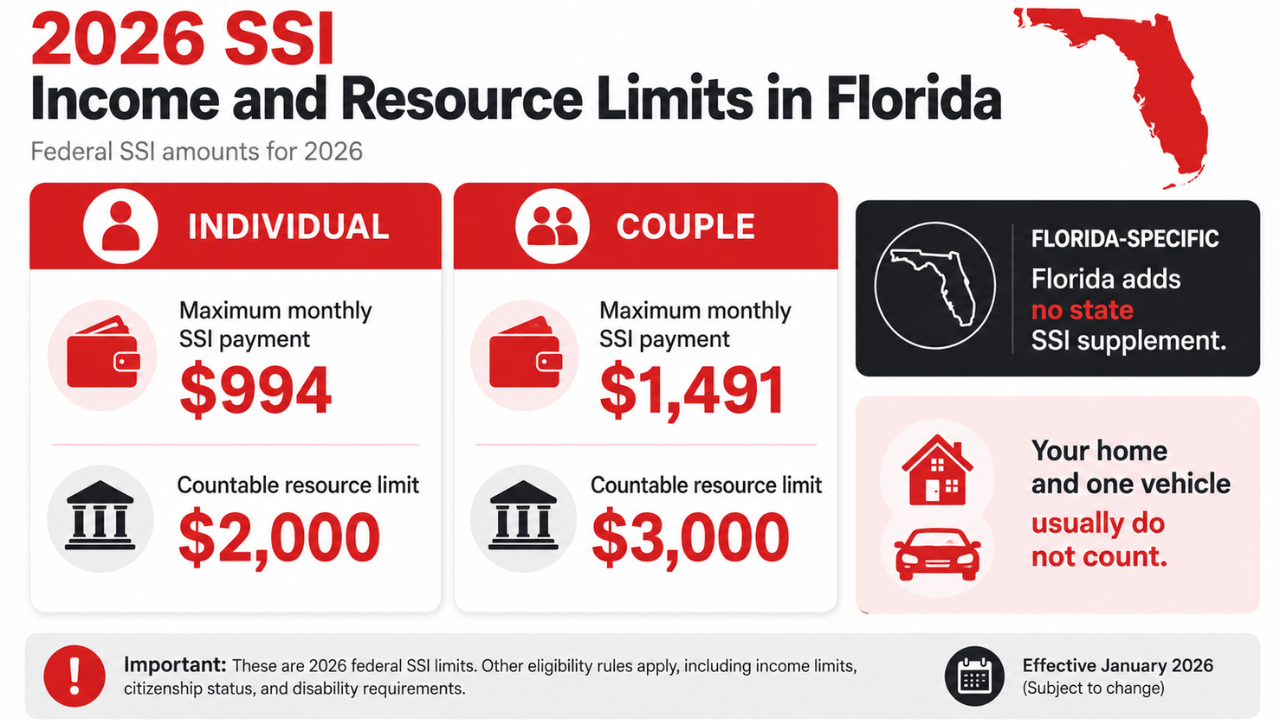
As of January 2026, the maximum federal SSI payment is $994 per month for an individual and $1,491 per month for a couple. Florida does not provide a state SSI supplement. Most people in Florida receive only the federal SSI payment.

If you meet the age, disability, income, and resource requirements, you may qualify for SSI. This guide explains who qualifies for SSI benefits in Florida, common reasons applications are denied, and how Florida residents can apply. It also includes information for children, older adults, and people living across the state.

SSI Limits in FLorida

Free case review: Contact our Florida SSI attorneys to find out if you qualify before you apply.

Who Qualifies for SSI in Florida in 2026

Who Qualifies for SSI in Florida in 2026

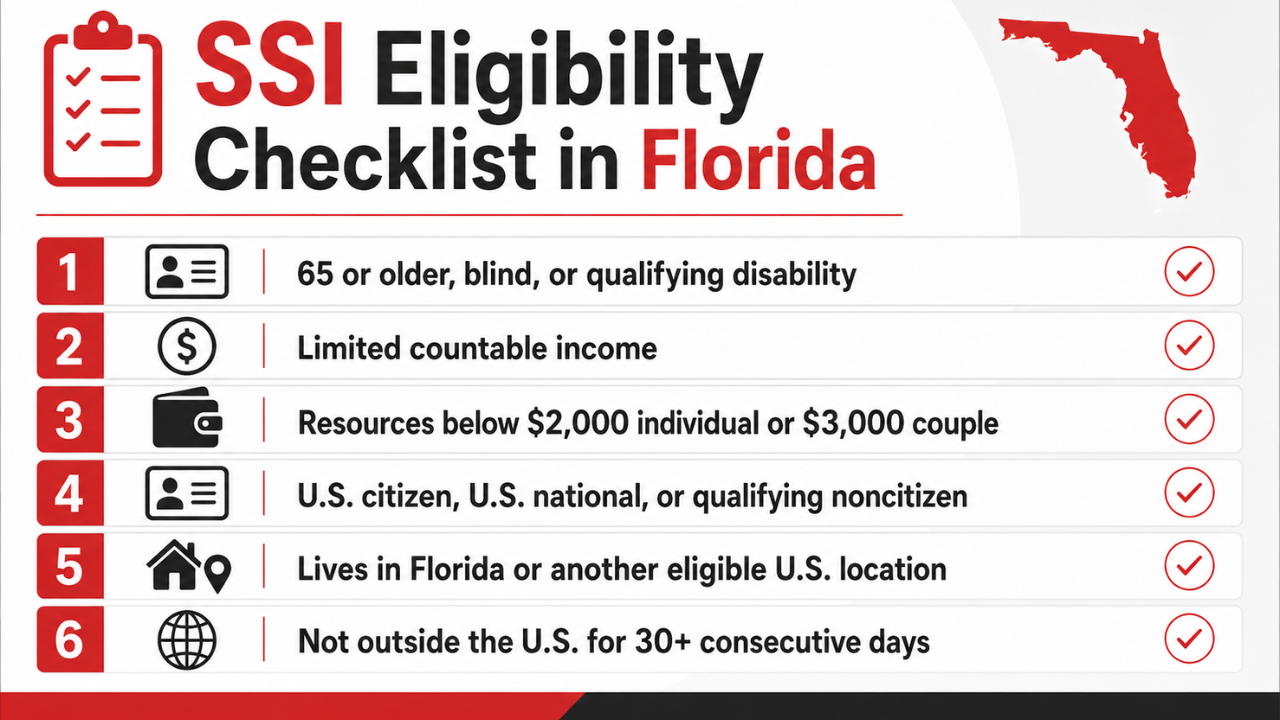
You may qualify for SSI in Florida if you meet all of these requirements:

  • Age or disability: You are 65 or older, blind, or have a disability that is expected to last at least 12 months or result in death.
  • Income: Your countable monthly income is within the SSI limits.
  • Resources: Your countable resources are less than $2,000 if you are single or $3,000 if you are a couple.
  • Citizenship and residency: You are a U.S. citizen, U.S. national, or a qualifying noncitizen, and you live in Florida or another eligible U.S. location.
  • Institutional status: You are not living in a government-funded institution, such as a prison, for a full calendar month.
  • Time outside the U.S.: You have not been outside the United States for 30 or more consecutive days.

You do not need a work history to qualify for SSI. SSI is based on financial need. It is different from SSDI, which is based on your work history and the Social Security taxes you have paid.

SSI Income and Asset Limits in Florida (2026)

SSI Income and Asset Limits in Florida

CategoryIndividualCouple
Maximum monthly SSI payment (Federal Benefit Rate)$994$1,491
Countable resource limit$2,000$3,000
Substantial Gainful Activity (SGA) limit – non-blind$1,690/month
Substantial Gainful Activity (SGA) limit – blind$2,830/month
Florida state supplement NoneNone 

What Counts as Income?

The SSA counts many types of income, including:

  • Wages from a job
  • Social Security benefits 
  • Pension payments
  • Unemployment benefits
  • Workers’ compensation
  • Cash gifts from family or friends


The SSA does not count the first $20 of most unearned income each month. It also does not count the first $65 of earned income. After these exclusions, your SSI payment is generally reduced by about $1 for every $2 you earn from work.

What Counts as a Resource?

Resources include:

  • Cash
  • Money in bank accounts
  • Stocks and bonds
  • Property that you can sell for cash

Some resources do not count toward the limit. These include:

  • Your primary home
  • One vehicle

If your disability began before age 46, you may also be able to save money in an ABLE account. Up to $100,000 in the account does not count toward the SSI resource limit.

Why Does This Matter in Florida?

Florida does not provide a state SSI supplement. People who qualify for SSI in Florida receive only the federal payment. Because there is no extra state payment, it is important to submit a complete and accurate application the first time. This can help you avoid delays or a denial of your claim.

SSI Eligibility for Children with Disabilities in Florida

SSI Eligibility for Children with Disabilities in Florida

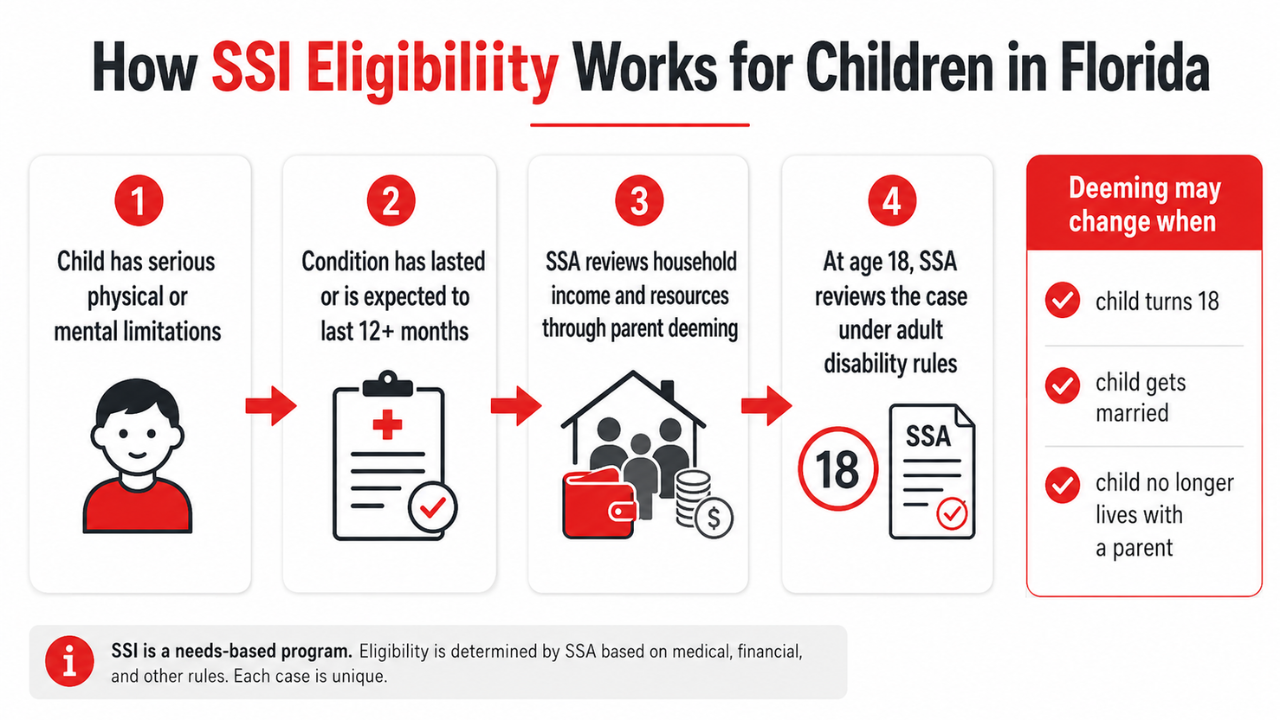
A child under 18 may qualify for SSI in Florida if they have a physical or mental disability that causes serious limitations in daily life. The disability must have lasted, or be expected to last, at least 12 months. A child may also qualify if the condition is expected to result in death. There is no minimum age for SSI. Children can qualify from birth.

Most children do not have their own income. Because of this, the Social Security Administration (SSA) usually counts part of the parents’ income and resources when deciding if the child qualifies. This is called deeming.

Deeming usually ends when:

  • The child turns 18
  • The child gets married
  • The child no longer lives with a parent

In 2026, a household with one working parent and one child applying for SSI may still qualify if the parent’s earned income is up to about $4,101 per month. The income limit is usually higher for households with two parents or more children.

In some situations, the SSA does not apply deeming. These include:

  • The parent receives Temporary Assistance for Needy Families (TANF).
  • The parent receives a needs-based VA pension.
  • The child has income of their own.
  • More than one child with a disability is applying for SSI in the same household.

When a child turns 18, the SSA reviews the case using the adult disability rules. This review usually takes place at the child’s next scheduled eligibility review.

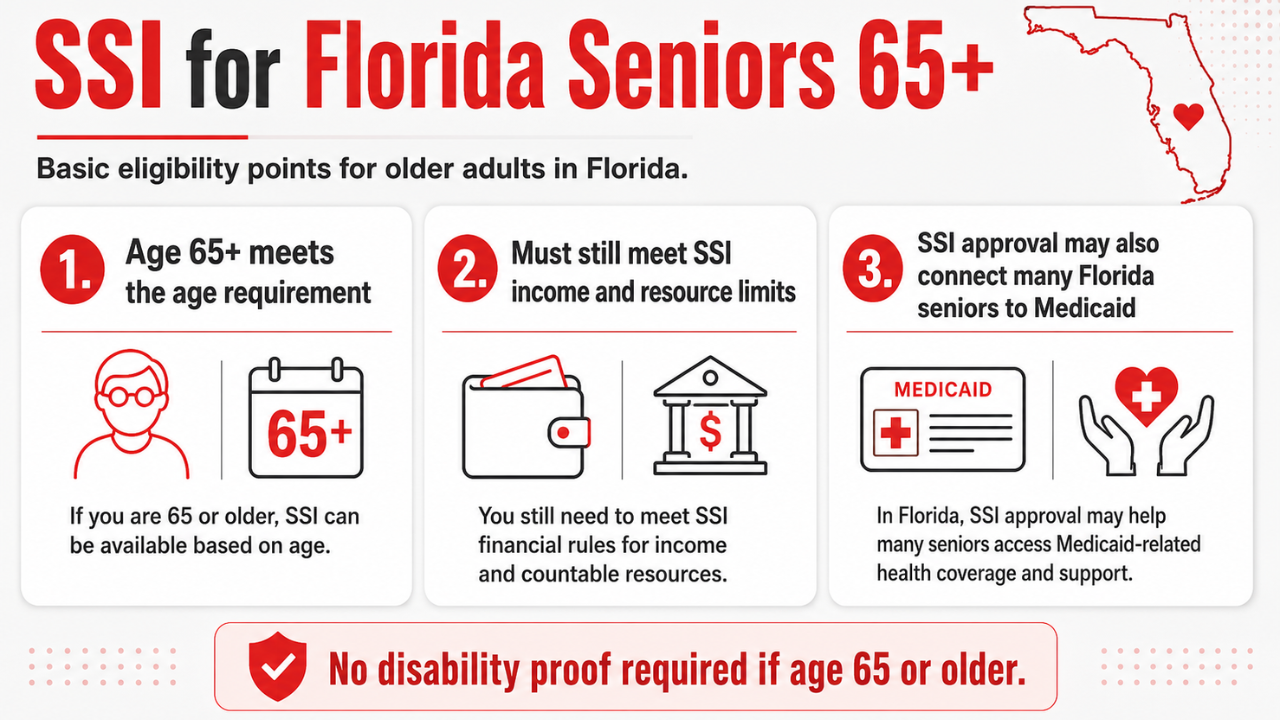
SSI Eligibility for Florida Seniors 65+ (No Disability Required)

If you are 65 or older, you do not need to have a disability to qualify for SSI. Your age meets that requirement.

You must still meet the SSI income and resource limits. In 2026, your countable monthly income must be within the SSI limits. Your countable resources must be less than $2,000 if you are single or $3,000 if you are a couple.

SSI can help older adults who did not work long enough to qualify for Social Security retirement benefits. It can also help seniors whose retirement income is very low.

Many Florida seniors who receive SSI also qualify for Medicaid. Medicaid may help pay for services that Medicare does not cover, including long-term personal care.

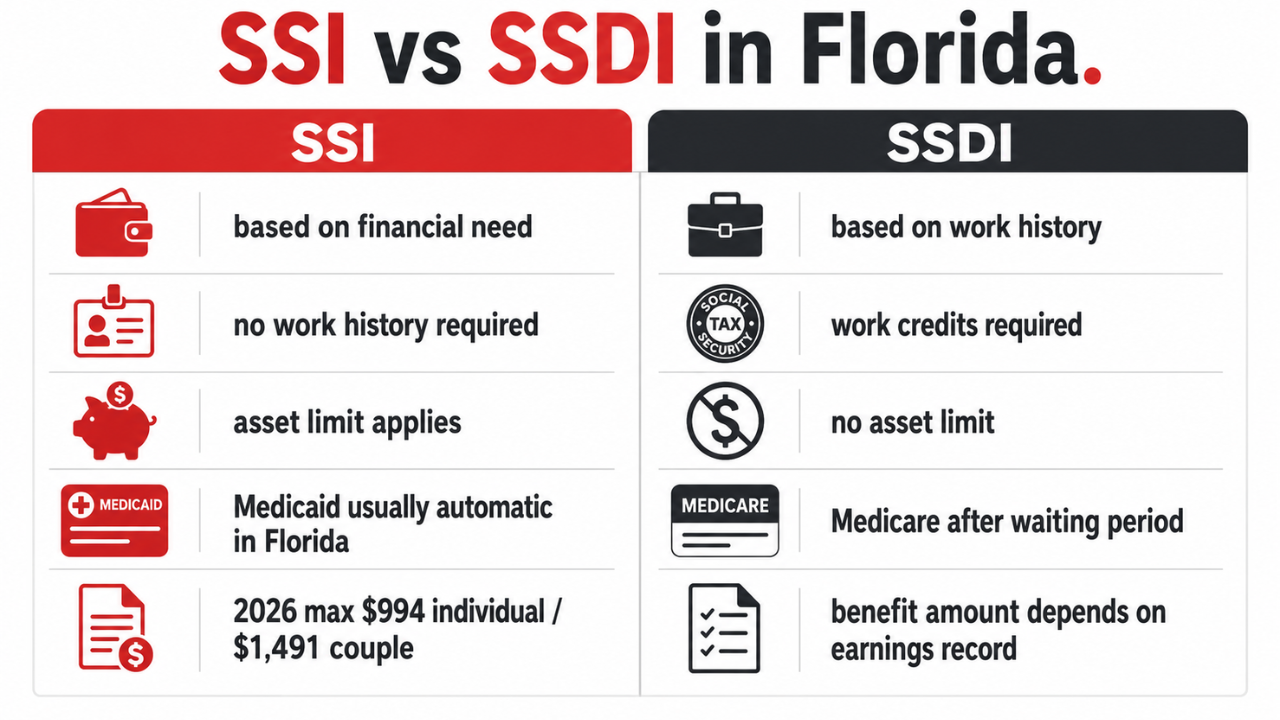
SSI vs. SSDI in Florida: Key Differences

SSI vs. SSDI in Florida: Key Differences

SSISSDI
Basis for eligibilityFinancial needWork history / Social Security taxes paid
Work history required?NoYes, sufficient work credits 
Funded byU.S. Treasury general fundsSocial Security payroll taxes
2026 max monthly benefit$994 individual / $1,491 coupleUp to $4,152 (average ~$1,630)
Automatic health coverageMedicaidMedicare (after a 24-month waiting period)
Asset limit$2,000 / $3,000None
Age 65+ without a disability?EligibleNot eligible under disability rules

Some people qualify for both SSI and SSDI. This is called concurrent benefits. It usually happens when an SSDI payment is low enough that the person’s total income still meets the SSI income limits.

This is common for people who have a limited or interrupted work history.

When you apply for SSI, the Social Security Administration (SSA) also checks if you qualify for SSDI. Applying for one program does not prevent you from receiving the other if you meet the requirements.

How to Apply for SSI in Florida

How to Apply for SSI in Florida

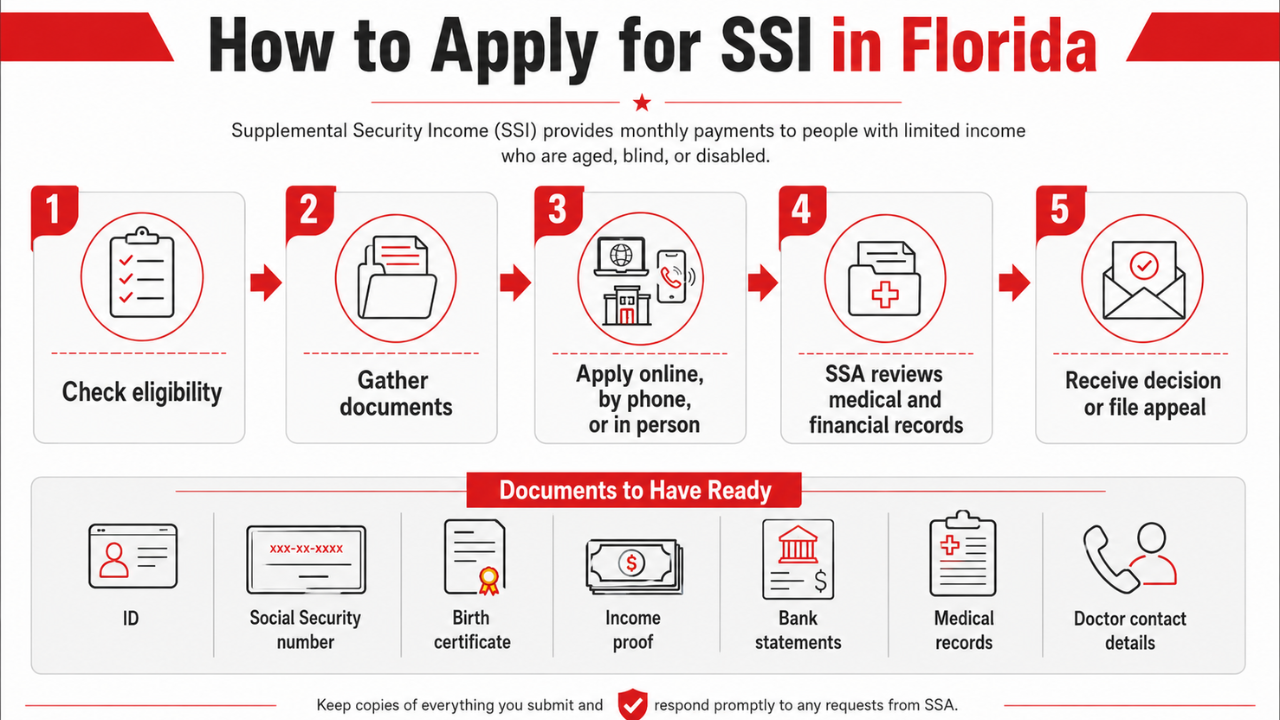
You can apply for SSI in Florida in three ways:

  • Online: Apply at ssa.gov if you are between 18 and 65 years old, have never been married, and have never applied for or received SSI.
  • By phone: Call 1-800-772-1213 (or 1-800-325-0778 for TTY) to schedule an appointment.
  • In person: Visit your local Social Security office.

What Should You Bring?

Bring the following documents to your appointment:

  • A government-issued ID
  • Your Social Security number
  • Your birth certificate
  • Proof of income, such as pay stubs, tax records, or benefit statements
  • Proof of resources, such as bank statements, property deeds, or vehicle titles
  • The names and contact details of your doctors, hospitals, and clinics
  • Medical records and test results related to your condition

The Social Security Administration (SSA) usually takes 3 to 6 months to make an initial decision. It is a good idea to apply as soon as you think you may qualify. If your claim is approved, your benefits are generally paid from your application date, not from the date your claim is approved.

Social Security Offices in Florida

Florida has Social Security field offices and disability hearing offices across the state. You can find offices in cities such as Miami, Tampa, Orlando, Tallahassee, Jacksonville, Fort Myers, Ocala, and Pinellas Park.

Wait times can vary from one office to another. Some offices, especially in South Florida, may have longer wait times than the national average.

Nationwide Disability Representatives can help you find the correct Social Security office for your address. We can also help you request a transfer to a different hearing office if it may reduce your wait time.

What Disqualifies You From SSI in Florida

What Disqualifies You From SSI in Florida

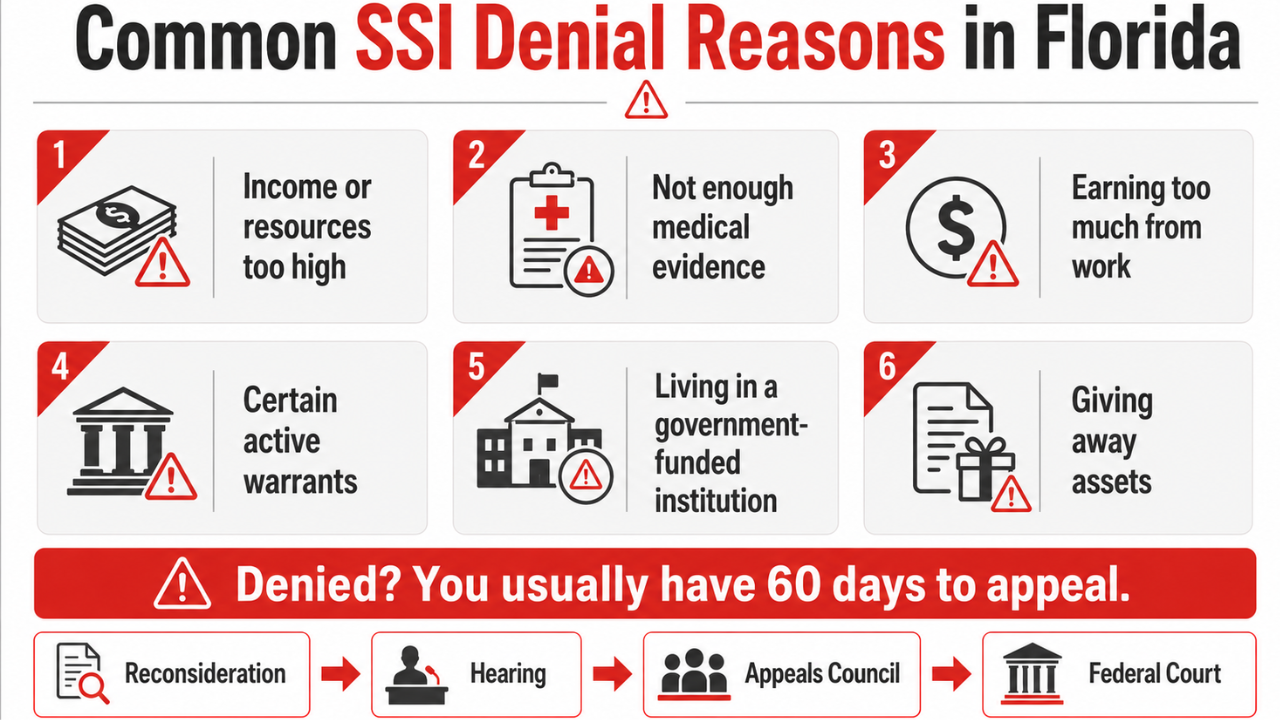
The Social Security Administration (SSA) may deny your SSI application for several reasons. The most common ones include:

  • Income or resources are too high: Your countable income or resources are above the SSI limits. This is the most common reason for a denial.
  • Not enough medical evidence: The SSA does not have enough medical records to confirm your condition or how serious it is.
  • Earning too much from work: If you earn more than $1,690 per month (or $2,830 if you are blind), the SSA may decide that you can do substantial work.
  • Certain felony or arrest warrants: You have an active warrant for escape, fleeing to avoid prosecution, or a similar offense.
  • Living in a government-funded institution: You are in a prison, jail, or another government-funded institution for a full calendar month.
  • Giving away assets: You transfer or give away resources to get below the SSI resource limit. This may result in a penalty period of up to 36 months.

Many SSI disability applications are denied the first time. If your application is denied, you still have options.

You have 60 days to file an appeal. The appeal process has four stages:

  • Reconsideration
  • A hearing before an Administrative Law Judge
  • Appeals Council review
  • Federal court review

It is usually better to appeal than to submit a new application. An appeal keeps your original application date. This can help you receive any back pay you are owed if your claim is later approved.

Florida Disability Lawyers You Can Trust

At Nationwide Disability Representatives, our Florida team of disability lawyers focuses its practice on Social Security Disability Insurance (SSDI) and SSI disability claims, including appeals for applicants who have already been denied. With deep experience in how Florida’s disability claims are evaluated, we help applicants avoid common mistakes, build stronger applications, and improve their chances of approval.

Frequently Asked Questions


Professionalism and Integrity

Our team work with honesty and ethics. We keep our promises and take responsibility for both our successes and mistakes.

Client Satisfaction

We learn about our clients' needs, challenges, and goals. So, we strive to provide valuable services while ensuring security and confidentiality.

Transparency

We address issues as they come up and maintain clear communication. Our billing is straightforward, with no hidden surprises.

Turning Problems Into Opportunities

We help our clients by providing innovative, value-added legal advice while improving our ability to adapt and succeed as a firm.