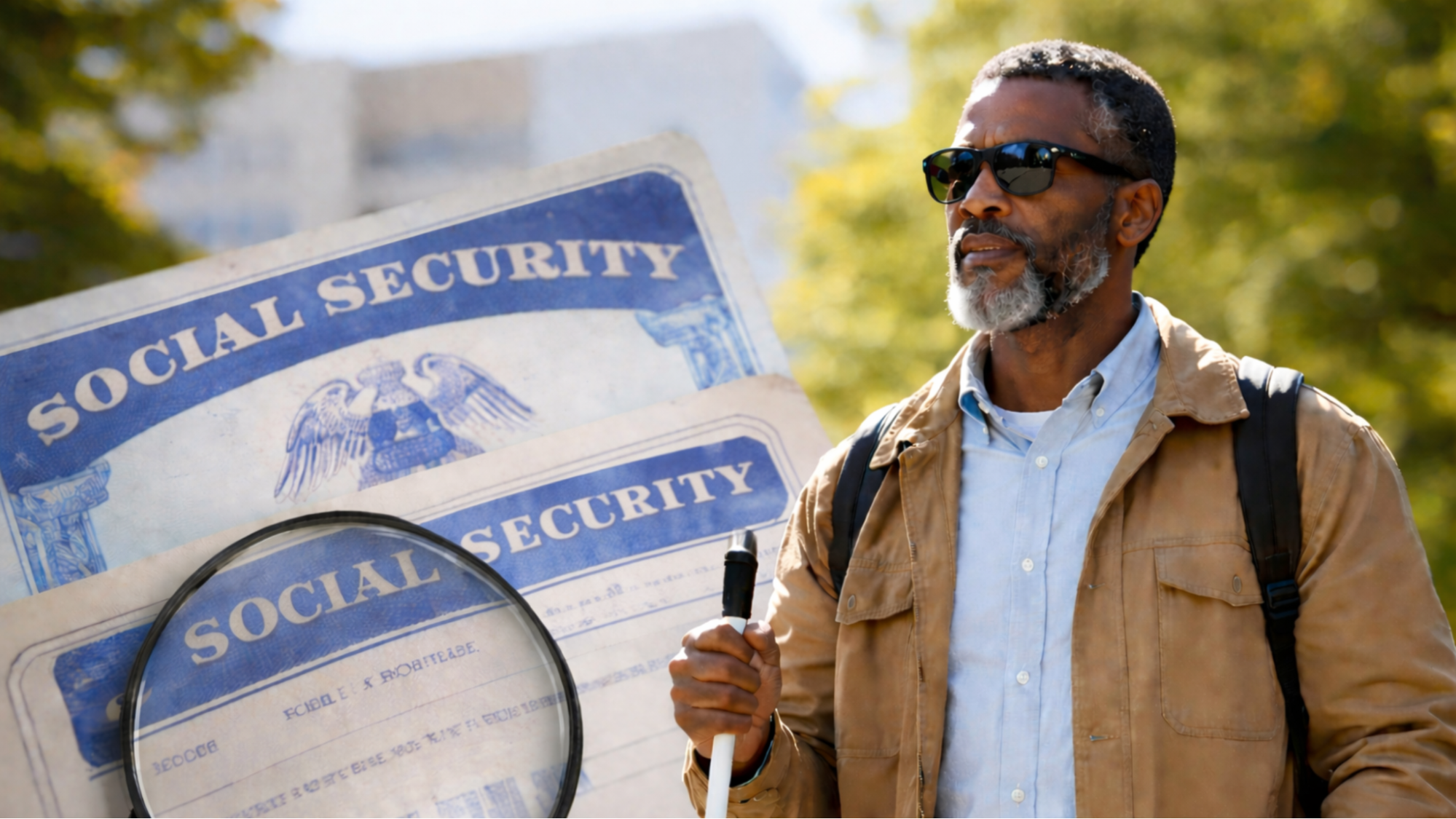
Social Security Disability Benefits for the Blind in Cape Coral, FL
Social Security treats blindness under separate, more favorable rules. You are considered legally blind if vision in your better eye cannot be corrected beyond 20/200, or your visual field is 20 degrees or less. Blind applicants may earn up to $2,830 per month and still qualify. Our Cape Coral, FL attorneys handle these claims. Call 1-800-572-3753 or see SSI eligibility.
What Is the Legal Definition of Blindness?
Social Security’s standard is specific. You meet it if the vision in your better eye cannot be corrected to better than 20/200, or if your visual field in that eye is limited to 20 degrees or less.
Correction matters. Vision is assessed with your best available correction, so glasses or contact lenses are taken into account. If corrective lenses bring you above the threshold, you do not meet the statutory blindness standard — though you may still qualify under the ordinary disability rules if your vision prevents you from working.
A Higher Earnings Limit
Most disability applicants must not earn more than $1,690 per month to be considered unable to perform substantial work. For blind applicants the figure is $2,830 per month.
That difference is significant. It recognizes that many blind people can work in some capacity while still facing genuine barriers to sustained full-time employment.
Rules That Apply Only to Blind Claimants
Freeze on your earnings record. Years of low or no earnings caused by blindness can be excluded when calculating your benefit, protecting the amount you eventually receive.
Work incentives. Blind SSDI recipients can deduct work expenses connected to their blindness from countable earnings.
Age 55 and over. A special rule applies for blind claimants aged 55 or older who cannot perform work requiring skills comparable to their previous employment.
SSI for blind children. Children who meet the blindness standard may qualify for SSI, subject to household income rules.
The Evidence That Matters
Claims rest on documented visual acuity and visual field testing from an ophthalmologist or optometrist, using standardized measurements.
Where blindness results from a progressive condition, records showing that progression carry weight — as does evidence of how the impairment affects daily function, not just the numbers on a chart.
Partial Vision Loss
Not meeting the statutory definition does not end your claim. Significant vision loss that falls short of legal blindness can still support a disability claim under the standard rules, particularly combined with other conditions.
Vision loss alongside diabetes, neurological conditions or musculoskeletal impairments frequently produces a stronger combined claim than any single condition would alone. Social Security is required to consider the cumulative effect, though it does not always do so without prompting.
Talk to a Cape Coral Disability Attorney
Free consultation, fees only from approved back-pay. Call (239) 549-6689 or contact our office.
Social Security has a very specific definition of blindness.You’re considered legally blind if:
Your vision is 20/200 or worse in your better eye with correction, or
Your visual field is extremely limited (20 degrees or less)
This is stricter than how people casually use the term “blind,” so medical documentation is key.
Yes. People who meet Social Security’s definition of blindness can qualify for benefits under either SSDI or SSI.Even if you’re not completely blind, you may still qualify if your vision problems are severe enough to limit your ability to work. The decision isn’t just about diagnosis—it’s about how your condition affects daily functioning.
The medical rules for blindness are similar, but the programs themselves are different:
SSDI (Social Security Disability Insurance)
Based on your work history
Requires work credits
Your condition must last at least 12 months
SSI (Supplemental Security Income)
Based on financial need
No work history required
No duration requirement specifically for blindness
So, SSDI is tied to your past work, while SSI is more about your current financial situation.
Yes-and the rules are actually more flexible for blind individuals.Social Security allows higher earnings limits for people who are blind. For example, earnings above a certain level (called Substantial Gainful Activity) may affect eligibility, but the threshold is higher than for other disabilitiesThere are also special work incentives that let you deduct certain work-related expenses.
You’ll need objective medical proof, not just a diagnosis.This usually includes:
Eye exam results showing visual acuity or field loss
Reports from ophthalmologists or optometrists
Test results and treatment history
Social Security may also request additional exams if the existing records aren’t enough to make a decision.
In most cases, it takes about 6 to 8 months to receive an initial decision.However, some claims—especially those with clear medical evidence—may be processed faster. If the claim is denied and you need to appeal, the process can take much longer.
Yes, it’s possible.If your vision problems don’t meet the strict definition of blindness, Social Security will evaluate your condition under its general disability rules.You may still qualify if your vision issues significantly limit your ability to work, read, drive, or perform everyday tasks.
Income limits depend on the program, but blind applicants are given more flexibility.For SSDI: In 2026, the monthly earnings limit for blind individuals is $2,830. Earning more than this amount is generally considered Substantial Gainful Activity (SGA) and may affect your eligibility for benefits.For SSI: The standard 2026 federal income limit for an individual is $994 per month, and the asset limit is $2,000. However, blind applicants can use Blind Work Expenses (BWE) to deduct nearly all costs related to working (including taxes and transportation) from their countable income, which allows them to earn significantly more while still qualifying for a payment. Additionally, for blind individuals, the SGA limit does not apply when determining initial or ongoing SSI eligibility.
Yes, in some cases.If your SSDI payment is low and you meet SSI income requirements, you may qualify for both benefits at the same time (this is often called “concurrent benefits”).Social Security will coordinate the payments rather than fully stacking them.
No, you’re not required to have a lawyer.However, if your case involves incomplete medical records, prior denials, or complicated work history, having legal help can improve your chances and reduce delays. For straightforward cases, many people apply on their own successfully.
I work with MS. Dina & Melissa and today we got a WIN!!!!!! On the first go around I worked with three different law firms I have been applying for 3 years I ran across a young lady that just gotten a win with Berke Law Firm, P.A. So she referred me to Berke Law Firm, P.A. When I call or email they respond and we work together. Thank you so much for all you are all help MS. Dina & Melissa
Denis
Saying thank you and leaving this review about Mr. Berke and Melissa simply does not seem like enough in expressing how much gratitude I feel for the help they gave me. When many other law firms in town that run fancy commercials on TV turned me away 3 years ago, Mr. Berke accepted my case without hesitation. And all this was in the midst of a worldwide pandemic. For 3 years Mr. Berke and Melissa fought for me and always treated me with dignity and respect. They were patient and kind even as our adversary took their sweet time processing my case. I eventually received far more than I expected and both Mr. Berke and Melissa have my eternal and heartfelt THANK YOU FOR EVERYTHING!!!! I am so happy there are still people out there like them!!!!
Rick Wood
Great law team from start to finish. They took my case and made the process so much easier. Thank you all for your help! Highly recommend if you are in need of their services.
Our Core Values
Professionalism and Integrity
Our team work with honesty and ethics. We keep our promises and take responsibility for both our successes and mistakes.
Client Satisfaction
We learn about our clients' needs, challenges, and goals. So, we strive to provide valuable services while ensuring security and confidentiality.
Transparency
We address issues as they come up and maintain clear communication. Our billing is straightforward, with no hidden surprises.
Turning Problems Into Opportunities
We help our clients by providing innovative, value-added legal advice while improving our ability to adapt and succeed as a firm.
Do You Need Help With a Disability-Related Problem?